
Colleges & Universities
Build language skills. Communicate with confidence.
Bring French, English and Spanish to life with structured resources that complement your language courses. Connect instructor-led lessons with independent practice and meaningful communication, while following student progress.
- Structured language resourcesConnected lessons and clear proficiency pathways.
- Teaching & independent practiceConnect classroom instruction with practice beyond class.
- Progress insightsUnderstand starting points and follow student development.
MADE FOR THE WORK YOU DO
Explore Smash by your role.
Support your college or university’s language programs with structured French, English and Spanish resources. Explore what matters to you—whether you lead a program, teach courses or support a language centre or lab.
Language Instructors
Language Centre & Lab Teams
FOR DEPARTMENT & PROGRAM LEADERS
Elevate your language programs. Support every learner.
Strengthen your college or university’s French, English and Spanish language programs with structured learning resources, meaningful communication activities and flexible practice. Support your instructors, connect classroom and language-lab learning, and follow student progress across courses and levels.
- Strengthen your department’s language offering.
- Support instructors across courses and levels.
- Extend practice through classrooms, labs and independent study.
- Make student activity and progress easier to follow.

EXPLORE WHAT MATTERS TO YOU
Stronger programs. Better learning experiences.
Explore structured curriculum, practical instructor support and flexible language learning for your department.
CURRICULUM & CEFR ALIGNMENT
Structured content. Clear progression. More communication.
Give your college or university language program a shared foundation without limiting instructor flexibility. Smash connects vocabulary, applied grammar and real-life communication through structured French, English and Spanish resources, with CEFR-aligned pathways to support progression across proficiency levels.

Ready-to-teach content
Interactive lessons and prepared activities help instructors spend less time creating resources and more time supporting students.
CEFR-aligned progression
Clear proficiency pathways help your team select appropriate content and connect practice with course objectives.
Put language to use
Level-appropriate situational videos show vocabulary and applied grammar in natural conversations. Action-oriented tasks help students use what they have learned.
Flexibility for your courses
Select and organize resources around course goals, student starting points and instructor priorities.
FLEXIBLE TEACHING & LABS
Your online language lab. In class and beyond.
Give your college or university students more opportunities to practise listening, speaking, reading and writing. Use Smash across French, English and Spanish courses for instructor-led lessons, language-lab sessions and independent study—extending meaningful practice across campus and home.
Online language lab
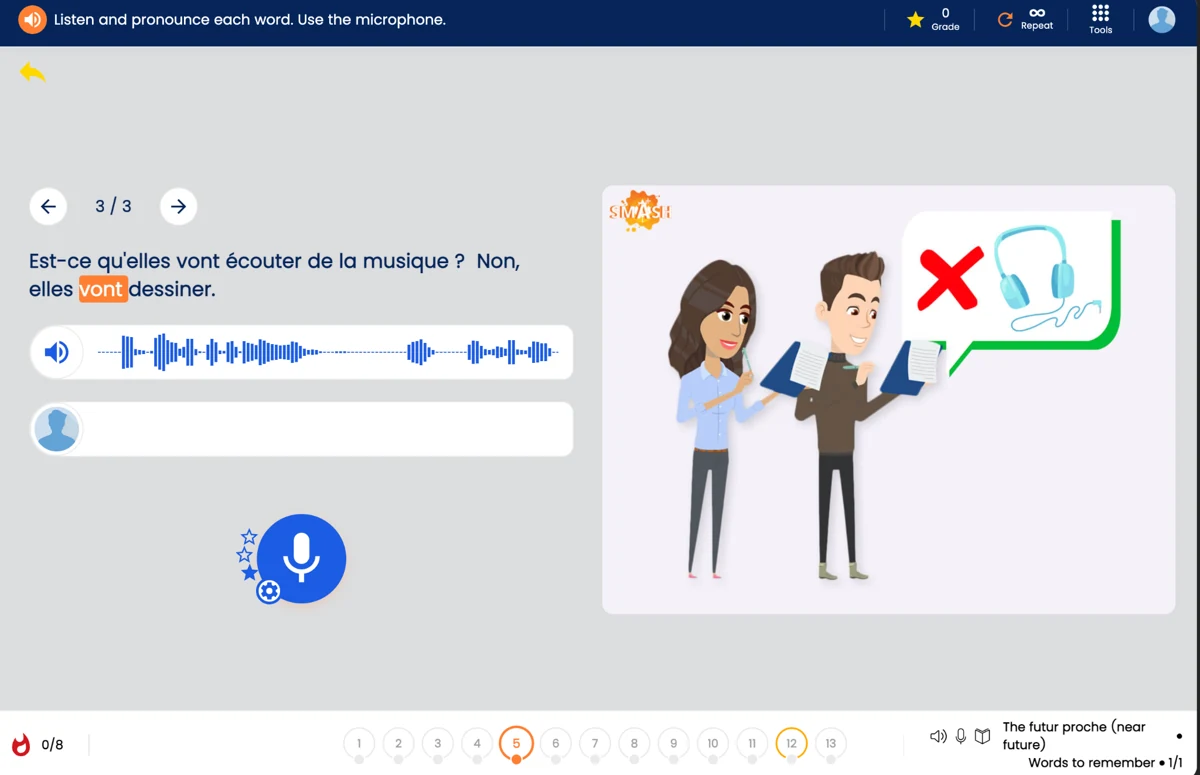
Bring listening, speaking and recording activities into your courses, giving students more opportunities to practise using the language.
On campus and at home
Keep practice connected beyond scheduled classes. Students can access Smash through a browser on computers or the app on supported tablets and phones. An internet connection is required.
Speaking practice & feedback
Give students opportunities to practise pronunciation with automated feedback, helping them prepare to communicate with greater confidence.
Flexible assignments
Choose activities for lab sessions, homework or independent study. Adapt practice to course goals and different proficiency levels.


REPORTS & PROGRESS
Clear data. Deeper insights. Better-informed decisions.
Track student participation and progress across your college or university’s language courses. Use Smash reports to support instructors, review learning needs and inform planning for your French, English and Spanish programs.
Real-time progress tracking
Follow completed activities, practice time and results to identify where students may need support.
Detailed reports for instructors
Review class and individual results, participation and activity responses to guide teaching and feedback.
Department-wide insights
Bring relevant reports into discussions with instructors to review patterns across participating courses.
Showcase learning outcomes
Use skill results and completed work to discuss progress toward course objectives and program goals.

From reports to program planning
- Participation
- Skill results
- Course review
DEPARTMENT PILOTS
A focused pilot. A clearer decision for your department.
Explore Smash in your own college or university language courses with a supported department pilot. Start with selected courses and instructors, see how the resources work with your students, and review participation, progress and feedback before deciding whether to expand.
Define the pilot scope
Choose participating courses, instructors, proficiency levels and a timeline that reflects your department’s goals.
A straightforward start
Work with our team to organize access, prepare classes and select initial resources, with practical guidance to help your instructors get started.
Support instructors and learners
Help your teaching team get started with onboarding, training, tutorials and practical support throughout the agreed pilot.
Review results. Plan your next step.
Review student participation, activity results and instructor and learner feedback with our team. Discuss whether to expand, adjust the approach or conclude the pilot—and what a broader rollout could involve.

IMPLEMENTATION & INSTRUCTOR SUPPORT
Easy to implement. Easy for faculty to adopt.
Get your language department started with simple internet-based access, ready-to-use resources, practical training and ongoing support. Help your instructors teach with confidence.
Internet-based access
Use a browser on computers or the app on tablets and phones. Internet connection required.
Practical onboarding
Get help setting up classes, adding students and choosing ready-to-use resources.
Faculty training & resources
Help instructors use assignments, differentiated practice and reporting with training, tutorials and practical guidance.
Ongoing support
Give your instructors a point of contact for questions as they get started and continue teaching.
POSTSECONDARY TEACHING
More practice between classes. More insight for teaching.
Complement your course materials with structured digital practice, audio models and meaningful communication activities. Extend practice between classes and use available progress information to inform instruction.
Connect independent practice with what you teach.
Build oral proficiency through models, pronunciation and communication.
Reduce repetitive grading on automatically assessed activities.

More practice beyond classYou guide the course. Smash supports practice.
EXPLORE WHAT MATTERS TO YOU
Keep learning moving between classes.
For professors, lecturers and language instructors: choose activities that reinforce your teaching, support different starting points and encourage independent practice.
A connected foundation. Room for your goals.
French, English and Spanish programs bring structure to instruction. Select content and sequences that fit your learners and teaching priorities.
French
Connected lessons
English
Guided practice
Spanish
Meaningful communication
Build language foundationsPractise with guidanceUse language with purpose
A connected lesson path. Ready to teach.
A complete CEFR-based sequence for language courses. Preview the content, connect practice with course goals and select missions for different proficiency levels.
Plan the practice around your teaching.
Use ready-to-teach audiovisual content, printables and interactive activities. Select a full unit or specific missions and modules; set mission start dates, due dates and future release to organize practice in class and at home.
Structured resources that complement your courses.
Select and reorganize existing content to reinforce course objectives. Instructors and departments retain control of their curriculum, instruction and assessment. Smash does not award academic credit or replace accredited courses.
One resource. Different ways to teach.
Use selected resources alongside face-to-face, blended or online instruction, with independent practice between classes. Confirm content suitability for your adult learners during a demo.
Teach together
Use connected lessons, audio models and communication activities in educator-led instruction.
Practise independently
Select missions and modules for reinforcement or extension, in class or between sessions.
Different starting points
Use diagnostic and placement information to plan flexible groups and targeted practice. Combine digital activities with selected printables.
Use a supported browser, a compatible device and an internet connection. Printable resources complement digital learning; not every activity is available offline.
Build the foundations. Put language to use.
Connect the theme’s vocabulary and applied grammar with a level-appropriate video conversation, then use that language in purposeful tasks. Listening, speaking, reading and writing develop throughout.
Hear it. Practise it. Say it with purpose.
Native-speaker audio and pronunciation feedback support practice. Guided conversations and role-play scaffold a path toward more independent communication.
Language to use. Not just words to remember.
Bring thematic vocabulary and applied grammar into meaningful communication. Learners see a level-appropriate situational video modelling a natural conversation, then apply the language in written and oral action-oriented tasks alongside your course instruction.
From oral practice to meaningful communication.
Pronunciation practice and listening models help learners build foundational skills. Action-oriented speaking tasks let learners apply them. Recorded oral responses requiring professional judgment are evaluated by teachers—not automatically graded.
ListeningSpeakingReadingWriting
Automatically assessed activities provide immediate feedback as learners practise. Teachers evaluate action-oriented tasks and other responses that require professional judgment. Automatic feedback reduces routine grading; it does not replace teacher assessment.
Understand the practice. Plan the next step.
Review available progress and skills information alongside learner work, classroom observations and educator feedback.
Where should this learner begin?
Use diagnostic and placement assessments to select starting points and differentiated assignments for your cohort.
Which skills need attention?
Activity results and skills reports help identify strengths and areas needing practice.
What should I assign next?
Adapt practice using progress information and instructor observations.
Detailed reports. Clearer decisions.
Review student progress, grades, language skills and platform usage, alongside written responses and recorded oral work. Use the information to plan targeted instruction, reinforcement or extension.
A practical start. Help along the way.
Ready-to-teach resources, virtual training and accessible guidance help educators introduce Smash and use it with confidence.
Prepare the people leading it.
We offer virtual onboarding and training for program leads or instructors. Your lead can start first; the whole faculty need not attend.
Learn when it works for you.
Step-by-step video tutorials are built into the Teacher Portal, ready when you want to learn or revisit a tool.
A real team when you need one.
Educators can reach a member of the Smash team directly through live chat in the Teacher Portal.
Support that fits your implementation
Instructors can use Teacher Portal tutorials and contact our team directly through live chat. Confirm onboarding and support arrangements for your implementation.
Confirm training and support arrangements with Smash. Choose a program, access scope and starting point that suit your team.
LANGUAGE CENTRE & LAB ENQUIRY
Language Centre & Lab Teams
Dedicated language-centre and lab content is being prepared. In the meantime, discuss your learning environment, access needs and setup with our team.
Resources that strengthen your teaching.
Turnkey curriculum.
Give instructors a complete CEFR-based language sequence with connected lessons and ready-to-use resources. Support consistent course delivery without building every lesson from scratch.
One cohort. Different levels.
Use diagnostic and placement assessments to guide differentiated practice. Connect instructor-led teaching with work that matches each learner’s proficiency level.
More speaking. Real communication.
Develop oral proficiency through native-speaker models, pronunciation practice, guided conversations and meaningful communication tasks.
LANGUAGE CURRICULA FOR HIGHER EDUCATION
A complete language curriculum. Built for progression.
Structured learning pathways for college and university language instruction, with flexibility for independent practice and additional enrichment.
Choose a language to explore its pathways.
THE CORE CURRICULUM
French, from foundations to confident communication.
Connected CEFR-based lessons link vocabulary, applied grammar and communication, with listening, speaking, reading and writing throughout a structured French curriculum.
Support instructor-led courses and independent practice, with flexibility for different starting levels and visibility into learner progress.
Explore the French curriculum
Use connected lessons for introductory language learning. Instructors select content according to learners’ starting proficiency and course objectives.
Connect vocabulary and applied grammar with listening, speaking, reading and writing throughout the learning sequence. Different starting levels can receive appropriate practice.
Develop pronunciation and oral communication with native-speaker models, guided conversations and action-oriented tasks. Tasks requiring professional judgment remain instructor-evaluated.
Combine instructor-led teaching with independent assignments. Automatically assessed activities provide immediate feedback, while detailed reports help instructors identify strengths and next steps.
Structured · CEFR-based · Flexible
A clear path for language development.
Sequenced CEFR-based pathways, from foundational language development to increasingly independent communication.
- A1
Foundation
Build essential vocabulary and communication skills.
- A2
Elementary
Use more complex language in familiar contexts.
- B1
Intermediate
Communicate more independently in everyday situations.
- B2
Upper-intermediate
Express ideas in greater detail and engage in more nuanced communication.
Coverage depends on the selected language and program. Progression reflects each learner’s starting point and course goals.
RECOGNIZED FRAMEWORKS & CERTIFICATION
International reference. Practical preparation.
CEFRA recognized framework for language proficiency.
The CEFR describes what learners can do with a language. Smash offers CEFR-based pathways in French, English and Spanish, including A1, A2, B1 and B2, with coverage depending on the selected program.
Official CEFR informationDELFFrench-language certification preparation.
Selected French activities support practice in language skills relevant to DELF examinations. A recognized French-language credential can help learners demonstrate their proficiency.
Official examinations and certification are administered separately from Smash.
Official DELF informationEnglish
English for language learners, with a CEFR-based sequence that supports different starting levels and purposeful practice.
English / ELL · CEFR
Connect listening, speaking, reading and writing with structured independent practice. Instructors can use progress information to guide support.
Spanish
A CEFR-based Spanish sequence that connects structured progression with practical language use.
Spanish · CEFR
Build proficiency through a connected sequence and communication-focused practice, with visibility into each learner’s progress.
Spanish credentials: DELE
DELE is an official Spanish-language diploma issued by Instituto Cervantes on behalf of Spain’s education ministry. Learners may pursue it to document their language proficiency. Relevant Smash Spanish content includes DELE practice.
Smash supports practice and preparation. Official examinations and diplomas are administered separately.
CEFR: a clear reference for the next step.
The Common European Framework of Reference for Languages describes proficiency through what learners can do. Its levels and can-do descriptors give educators a shared reference for starting points, communication goals and structured progression. They can support teaching alongside local curriculum requirements.
A shared reference. Around the world.
The CEFR describes what learners can do with a language. Smash’s CEFR-based pathways include A1, A2, B1 and B2 content where available in the selected language and program. Use communication goals alongside local curriculum requirements, and confirm the actual coverage of your chosen Smash program.
Using ACTFL goals?
CEFR and ACTFL both describe what learners can accomplish with a language. That shared focus makes Smash’s communication-based learning relevant to these teaching goals. Their proficiency scales differ; a CEFR level is not an automatic ACTFL rating.
Explore NCSSFL–ACTFL Can-Do StatementsLEARNING YOU CAN PICTURE
Teach the course. Keep every learner moving.
Connect instructor-led learning with independent practice, oral development and useful progress information.
- 01
Introduce a meaningful task.
Use the curriculum sequence alongside your course goals. Model the language and make the communication purpose clear.
- 02
Practise between sessions.
Learners work on listening, speaking, reading and writing, with guided oral activities and practice selected for their proficiency level.
- 03
Bring progress into the next class.
Review written and oral responses alongside grades and skills reports. See where learners need feedback or further practice, and bring that insight into your next class.
A CLOSER LOOK AT CONNECTED LEARNING
Choose a tab. See one part of the experience at a time.
A connected lesson path. Ready to teach.
A complete CEFR-based sequence for language courses. Preview the content, connect practice with course goals and select missions for different proficiency levels.
Plan the practice around your teaching.
Use ready-to-teach audiovisual content, printables and interactive activities. Select a full unit or specific missions and modules; set mission start dates, due dates and future release to organize practice in class and at home.
Hear it. Practise it. Say it with purpose.
Native-speaker audio and pronunciation feedback support practice. Guided conversations and role-play scaffold a path toward more independent communication.
From oral practice to meaningful communication.
Pronunciation practice and listening models help learners build foundational skills. Action-oriented speaking tasks let learners apply them. Recorded oral responses requiring professional judgment are evaluated by teachers—not automatically graded.
Language to use. Not just words to remember.
Bring thematic vocabulary and applied grammar into meaningful communication. Learners see a level-appropriate situational video modelling a natural conversation, then apply the language in written and oral action-oriented tasks alongside your course instruction.
Immediate feedback. Teacher judgment where it matters.
Automatically assessed activities provide immediate feedback as learners practise. Teachers evaluate action-oriented tasks and other responses that require professional judgment. Automatic feedback reduces routine grading; it does not replace teacher assessment.
Detailed reports. Clearer decisions.
Review student progress, grades, language skills and platform usage, alongside written responses and recorded oral work. Use the information to plan targeted instruction, reinforcement or extension.
- Where should this learner begin?Use diagnostic and placement assessments to select starting points and differentiated assignments for your cohort.
- Which skills need attention?Activity results and skills reports help identify strengths and areas needing practice.
- What should I assign next?Adapt practice using progress information and instructor observations.
Watch the product overview
Existing English-language overview. Press play to watch.
Different proficiency levels?
Use diagnostic or placement results to guide differentiated assignments.
Who needs more practice?
Review results and language-skills information alongside your observations.
What comes next?
Adapt practice while keeping progression connected with instructor-led teaching.
A scaffolded path that connects what learners know with what they can say.
Explore the Smash Approach: Build it. Practise it. Use it.
THE SMASH APPROACH
Build it. Practise it. Use it.
Vocabulary, applied grammar and communication connect within a shared theme.
01 / VOCABULARY
Build vocabulary around a theme.
Learn useful words and expressions through visuals, listening models and interactive practice connected to the theme.
02 / APPLIED GRAMMAR
Apply it in context.
Practise grammar using the vocabulary you have learned, with sentence patterns that fit the theme and situations you could encounter.
03 / COMMUNICATION
Put language to use.
See the theme’s vocabulary and applied grammar come together in a level-appropriate situational video. Then use the language for a meaningful purpose in written and oral action-oriented tasks.
- Listening
- Speaking
- Reading
- Writing
Four interconnected language skills, developed throughout the learning journey.
Structured progression. Meaningful practice. Confident communication.
EASY TO START. SUPPORTED ALONG THE WAY.
From course goals to a confident start.
Plan around your course, cohort or department. Your program leads and instructors have support along the way.
Plan around your course.
Discuss learner profiles, program selection, course delivery and access for your cohort or department.
Log in. No installation.
Instructors and learners access Smash through a supported browser, with a compatible device and internet.
Prepare the people leading it.
We offer virtual onboarding and training for program leads or instructors. Your lead can start first; the whole faculty need not attend.
Learn when it works for you.
Step-by-step video tutorials are built into the Teacher Portal, ready when you want to learn or revisit a tool.
A real team when you need one.
Educators can reach a member of the Smash team directly through live chat in the Teacher Portal.
Instructors can use Teacher Portal tutorials and contact our team directly through live chat. Confirm onboarding and support arrangements for your implementation.
Canadian company, founded in 2015. Student names and personal email addresses are not required for access; platform servers are located in Canada.
PRICING & ACCESS
A course today. A wider conversation tomorrow.
Start with student licences. If you’re planning something much larger, let’s explore what could work.
STUDENT LICENCES
Your course. Your cohort.
For courses, classes, programs or defined groups of learners. Plan access around the students using Smash alongside instructor-led teaching.
- A defined number of student licences
- Structured independent and oral practice
- Instructor visibility into learner progress
PLANNING A LARGER IMPLEMENTATION?
Bring your bigger picture.
Considering a department, faculty, major program or university-scale implementation? Share your learner numbers, goals and requirements so we can explore whether an institution-level arrangement is possible.
- Review scope across courses or departments
- Discuss implementation and support requirements
- Explore an arrangement suited to your scale
STUDENT LICENCE REFERENCE
Per student, per year, for one language. Confirm access for your course in the student-licence proposal. Larger arrangements are explored individually.
International pricing · USD
Your subscribed curriculum, teaching tools, oral practice and reports work together. Confirm program access, support, billing, applicable taxes in your proposal.
The applicable market is confirmed using the billing or organisation information normally required for your proposal or purchase. Canadian pricing is for purchases for use in Canada.
Subscriptions do not renew automatically.
BEFORE YOU CHOOSE
Questions institutions ask.
Clear answers about language programs, instructor support, access and adopting Smash at your institution.
Programs & proficiency
Programs and course fit
Which programs are relevant to postsecondary learners?
French as a Foreign Language, English for language learners and Spanish provide structured, CEFR-based practice for postsecondary learners. Instructors can choose age-appropriate lessons for courses, language labs and independent study.
Review the available levels and sample resources against your department’s objectives to select the right program for your cohort.
Explore the curriculumCan Smash complement an accredited language course?
Yes. Instructors can combine Smash’s structured lessons, digital practice and enrichment with their existing course materials. They retain control of content selection, teaching sequence and academic assessment. Smash supports language practice within that course; academic credit is determined by the institution.
Explore course resourcesCan Smash support both independent practice and structured language courses?
Yes. Smash supports targeted independent practice, homework, reinforcement and specific language-learning objectives alongside structured instruction.
Its sequenced learning pathways help students progressively develop vocabulary, applied grammar and communication skills, with listening, speaking, reading and writing integrated throughout the learning experience.
Short activities can reinforce individual skills, while sustained engagement with connected lessons and meaningful practice supports broader language development.
Explore teaching and practiceWho develops Smash’s curriculum?
Smash Education develops and maintains its French, English and Spanish curricula. The approach combines purposeful lesson sequences, vocabulary and applied grammar, meaningful communication activities and resources for learners at different starting points.
Lessons and activities are refined and updated over time, while educators choose the content and practice that fit their learners.
Meet Smash EducationWhy does Smash include different accents and regional vocabulary?
Languages vary from place to place, and learning those differences is part of communicating confidently. Smash introduces learners to different accents and regional vocabulary in French, English, and Spanish—for example, French words used in both France and Quebec.
This exposure helps learners understand a wider range of speakers and recognize how the same idea can be expressed in different ways.
Levels, learner support and assessment
Which language levels are available for mixed-level cohorts?
CEFR-based content includes A1, A2, B1 and B2, with coverage depending on the selected language and program. Review lesson examples and available placement information to choose a starting point.
Instructors can assign different practice within a cohort and select reinforcement or extension according to learner needs; your course objectives and academic assessment remain under institutional control.
Can Smash accommodate different learning and accessibility needs?
Schools and districts have shared positive feedback about using Smash with autistic students, students who are hard of hearing, and students with speech or articulation difficulties. These reported experiences come from school settings.
Structured, sequenced learning can support a familiar routine, while differentiated content supports different language levels. Educators also report that some students with speech or articulation difficulties appreciate oral practice without feeling repeatedly penalized for their speaking differences.
Suitability depends on the learner, activities and support available; adaptations may be needed. Smash is not a specialist intervention or speech therapy tool.
Contact us to discuss your learners’ requirements, review relevant activities and explore whether the platform would be a suitable fit.How are assessment and course progress reported?
Diagnostic and placement assessments guide practice choices rather than provide official certification. Automatically graded activities give immediate feedback, and results are automatically available to teachers without manual correction.
For open-ended written and oral tasks, students use the “Submit to teacher” button in their portal to send work for teacher review. Learner and class reports show assigned activities, results and usage within authorized access. Participation data is distinct from language proficiency; review course-specific reporting during a demonstration.
Review assessment and reportsLearning progress
How long does progress toward academic or personal language goals take?
The journey depends on learners’ starting points, goals, prior learning, study opportunities and use of the language beyond lessons. Managing everyday exchanges is a different goal from following lectures or contributing to academic discussions.
Smash’s structured, CEFR-based pathways support purposeful practice and progression. Instructors and learners can set manageable goals and review listening, speaking, reading and writing separately: useful gains can happen along the way, and skills may develop at different rates.
CEFR levels describe language ability, not a fixed course duration. Available levels vary by language and program; completing activities does not automatically establish an independently assessed CEFR level.
Do learners need to complete every CEFR level in order?
Not necessarily. Learners who already know some of the language may be ready to begin beyond the introductory levels. The right starting point depends on what they can understand and do, rather than which courses they have completed.
However, moving ahead before they are ready can leave gaps that make later learning harder. Learners can build on their existing strengths, revisit foundations where needed, and work toward increasingly demanding tasks. They may also be stronger in some skills than others. Available levels depend on the selected language and program.
What helps learners make real progress in a language?
Combine regular, focused coursework and independent study. Choose a sustainable routine around learners’ schedules and academic or personal goals. Short activities reinforce learning; sustained sessions allow time to follow longer speech, understand a language pattern and develop an original response.
Smash connects vocabulary, applied grammar and communication through structured lessons and active practice across listening, speaking, reading and writing. Learners work beyond recognizing words toward understanding others and expressing their own ideas in the language they are learning. Revisiting foundations, using feedback and applying new learning help instructors and learners make purposeful choices about what to practise next.
Why can language progress feel slower at intermediate levels?
Progress can feel less noticeable when familiar conversations become manageable but longer speech, unfamiliar topics and more complex language still require effort. This is sometimes called an “intermediate plateau” or “B1 plateau”; it does not mean learning has stopped.
Smash combines scaffolded immersion, natural-speed speech and vocabulary and applied grammar practice within connected themes. Repeated practice helps learners connect ideas, choose language more precisely and respond more independently as they work toward B2, where offered.
Proficiency frameworks and education contexts
What is CEFR, and why does Smash use it?
Smash uses CEFR-based pathways to give learners and educators a structured reference for progression and communication goals. The Common European Framework of Reference for Languages (CEFR), developed by the Council of Europe, describes practical language abilities through “can-do” statements.
This shared reference works across languages and educational settings; activities and expectations still need to suit learners’ ages, goals and contexts. Explore the Council of Europe’s official CEFR overview and language proficiency descriptors.
Can Smash complement our institution’s language program?
Yes—compare shared language-learning goals. Smash’s CEFR-based pathways provide a structured reference for developing French, English and Spanish skills. Educators can compare learning objectives and identify relevant content, even when their local curriculum uses a different structure.
Developed by the Council of Europe, CEFR describes what learners can understand and do in a language. It also provides a reference for qualifications offered by Cambridge English, France Éducation international and Instituto Cervantes.
Review Smash’s pathways alongside your institution’s program requirements to identify support for instruction and practice. The fit depends on the language, available levels, learner needs and local objectives. These institutional references explain frameworks and qualifications; they do not certify Smash or establish automatic curriculum alignment or exam-preparation services.
Official references by language
How does CEFR relate to ACTFL proficiency levels?
For educators considering ACTFL goals, Smash’s CEFR-based pathways offer a reference for discussing language progression. Both frameworks describe what learners can do, but their levels and assessment systems differ.
ACTFL (American Council on the Teaching of Foreign Languages) worked with a European research group on linking and validation studies. Its official CEFR alignment page explains the assessment-specific findings.
What should educators keep in mind?
- The links are one-directional: they support assigning CEFR ratings to the ACTFL assessments studied, not automatic reverse conversion.
- Correspondences differ by skill: reading/listening tables are distinct from speaking/writing.
- Following a CEFR-based curriculum does not itself establish an official ACTFL proficiency rating.
How does CEFR relate to CLB and NCLC for adult newcomers?
Smash’s CEFR-based pathways can be considered alongside the benchmarks required by an adult newcomer program. Canada uses CLB (Canadian Language Benchmarks) for English and NCLC (Niveaux de compétence linguistique canadiens) for French in adult immigrant language learning.
The Centre for Canadian Language Benchmarks published research comparing CLB/NCLC and CEFR. These frameworks describe practical abilities; completing a Smash level does not establish an official CLB or NCLC rating.
The Government of Canada explains CLB/NCLC in federally funded newcomer classes; Quebec publishes its own adult French-language framework. Use these adult-program references alongside your required assessment practices, separately from school-age curriculum requirements.
Is CEFR used in language education in Latin America?
Yes. Official education documents in countries such as Mexico, Colombia and Chile reference CEFR when describing language-learning goals or proficiency. In Spanish, CEFR is known as MCER—Marco Común Europeo de Referencia para las Lenguas.
Mexico’s SEP CENNI documentation includes framework references. Colombia’s Ministry of National Education English-language competency standards (PDF) and Chile’s Ministry of Education English curriculum document (PDF) reference CEFR in English-language education.
These examples explain the relevance of CEFR-based pathways in the region. Requirements vary by country, institution, program and learner age. For K–12 schools, universities and adult learners reviewing Smash, CEFR provides a common reference for progression while local curriculum and certification requirements remain in view.
The Council of Europe’s official CEFR overview explains the shared framework behind these references.
Exams and further study
Can learners practice for language exams?
Selected French resources support DELF practice, and relevant Spanish resources include DELE practice. Review the activities and proficiency levels appropriate to your learners. Practice in Smash is separate from an official examination or certification; it does not award an official qualification or academic credit.
Explore the curriculumWhat French level do French-speaking universities require?
B2 is a commonly requested minimum for French-taught university programs in France, although some programs require higher proficiency. Requirements depend on the country, university, program and applicant background. Campus France: French-language levels for study explains the context.
Universities in Canada and elsewhere set their own accepted tests, minimum results and exemptions; see Université de Montréal: French-language admission requirements for an example. Always check your program’s official admissions page.
Smash’s CEFR-based pathways help structure learning goals within available levels. Admission depends on meeting the university’s requirements, including any required proof of proficiency.
How do DELF and DALF relate to CEFR levels?
Smash’s CEFR-based French pathways provide a reference for learning goals alongside official French qualifications. DELF covers A1, A2, B1 and B2; DALF is a separate diploma for more advanced proficiency, beyond Smash’s stated scope.
Earning either diploma requires passing its official examination separately. Completing a Smash level does not award a diploma or guarantee exam success. France Éducation international: Official French-language diplomas and tests explains the qualifications.
How do Smash’s English pathways relate to Cambridge English Qualifications?
Smash’s English pathways and Cambridge English Qualifications both use CEFR as a reference for progression. For postsecondary courses and independent study, this shared reference helps instructors and learners discuss English-language goals alongside external qualifications.
Cambridge English Qualifications include A2 Key, B1 Preliminary and B2 First, with qualifications for young learners and school-age versions. These English-language qualifications are distinct from Cambridge International school curricula.
Smash supports learning over time; a Cambridge exam assesses performance against its own requirements. Sharing CEFR levels does not establish identical content or exam readiness, and completing a Smash level does not award a qualification or guarantee an exam result. See Cambridge English: CEFR and international language standards.
How does CEFR relate to CENNI certification in Mexico?
In Mexico, the Secretaría de Educación Pública (SEP) provides the Certificación Nacional de Nivel de Idioma (CENNI), a national reference for evaluating and certifying language proficiency.
SEP/DGAIR’s CENNI information and its official CENNI questions and answers (PDF) explain the certification and reference information connecting its levels with other frameworks, including CEFR—called MCER, Marco Común Europeo de Referencia para las Lenguas, in Spanish.
For institutions reviewing Smash’s CEFR-based pathways, these references provide context for discussing language-learning goals. Obtaining a CENNI document is a separate process governed by SEP’s requirements and accepted assessment evidence; Smash results do not automatically convert into CENNI certification.
Subscriptions & privacy
How do institutional subscriptions work?
Institutional subscriptions normally use student licences for a course or defined group. With 10 or more student licences, a teacher licence is included at no additional cost. 1–9 student licences: an annual teacher licence is required alongside the student licences. Contact us for pricing.
Teacher licences accompany student licences; teacher licences are not sold separately. Your proposal specifies the billing currency, languages and access scope. Larger departmental or institutional implementations can be discussed separately.
Explore pricing & plansAre curriculum and platform updates included?
Standard curriculum and platform updates within your subscribed program are included during an active subscription, unless your plan or agreement specifies otherwise. Separately priced offerings are identified in the applicable offer or agreement.
What does instructor onboarding involve?
Onboarding starts with your language, cohort, course objectives and access requirements. Smash runs in a supported browser on a compatible internet-connected device, with no local installation. Virtual onboarding prepares program leads or instructors, while Teacher Portal tutorials and live chat support ongoing use.
Training scope and any technical review are planned for your implementation. Teachers can choose whether to enable direct messaging through Smash, allowing students to contact them within the portal.
Explore implementation and supportHow is learner information handled?
Smash does not require student personally identifiable information, and platform servers are located in Canada. Review the available details and discuss your institution’s requirements.
Explore Privacy & TrustLANGUAGE LEARNING FOR HIGHER EDUCATION
Explore a more connected approach to language education.
See how Smash can support language instruction, proficiency development and meaningful practice across your courses and programs.