Fast teacher access
Receive your district’s access code and share it with teachers so they can create their Smash accounts.
 Public Schools & School Boards

Public Schools & School Boards
Complete French, English and Spanish curricula for K–12 learners. Give teachers ready-to-teach lessons, meaningful oral practice and the tools to support every learner.
Canadian company · Founded in 2015
MADE FOR THE WORK YOU DO
Different responsibilities. One complete language education solution.
FOR DISTRICT & BOARD LEADERS
Give participating schools a consistent foundation for French, English and Spanish language education. With centralized reporting, simple account access and dedicated implementation support, Smash helps your team introduce, manage and grow language programs with confidence.
Receive your district’s access code and share it with teachers so they can create their Smash accounts.
Review usage and account activity across participating schools from one administrative portal.
Work with a District Success Partner who helps guide implementation and ongoing adoption.
Begin with a school or program and expand across your district according to your goals.

EXPLORE WHAT MATTERS TO YOUR DISTRICT
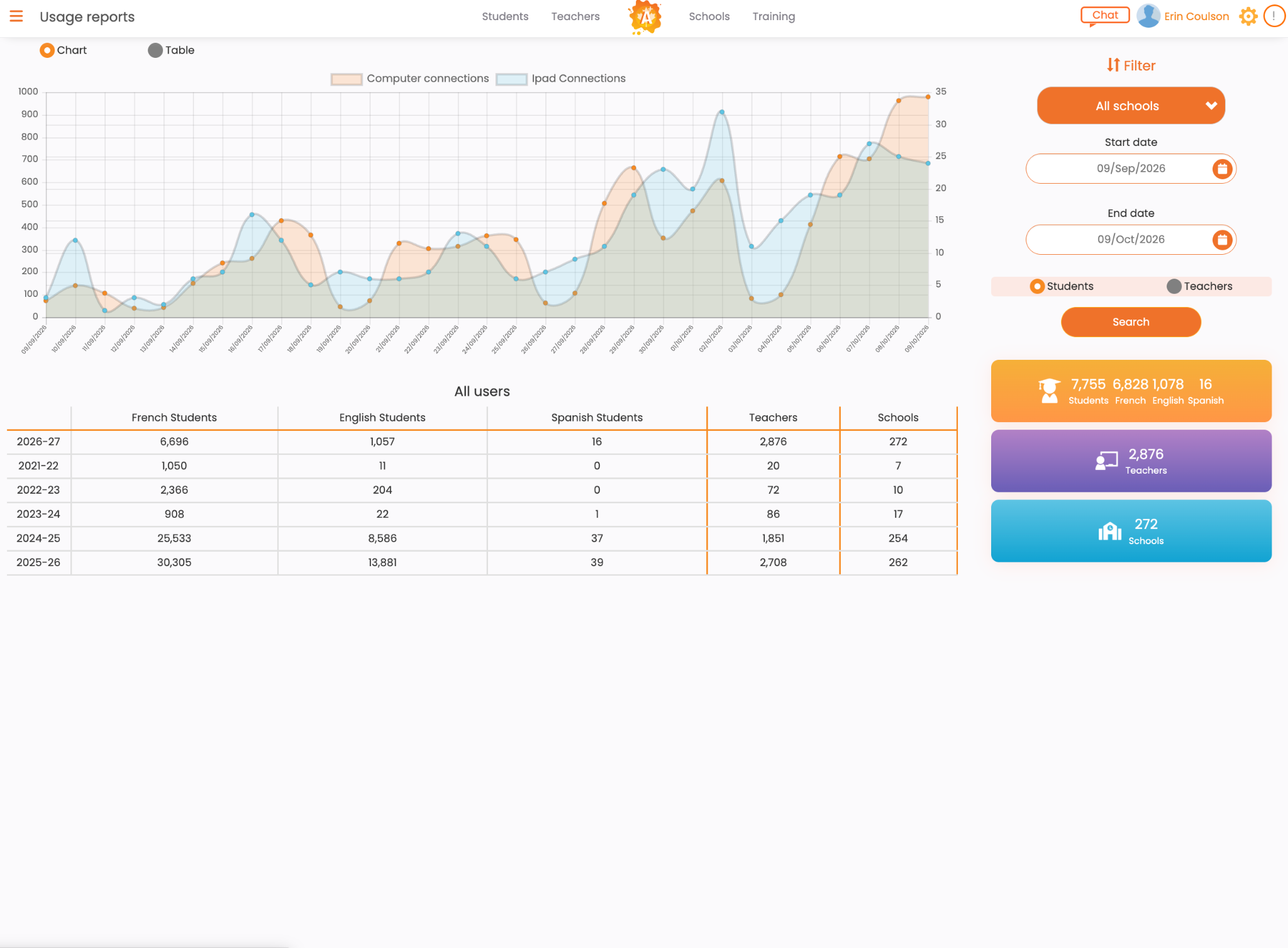
Get a clear view of platform usage and participation across your district, with the ability to explore information at the school level.

Review account activity and platform usage across participating schools from one centralized administrative portal.
Explore daily activity and account information for individual schools to understand participation and adoption.
View and manage schools, teachers and students within your authorized administrative scope.
Review daily usage reports and account totals to understand how Smash is being used across your schools.
Access survey results and responses alongside usage information to support implementation discussions and next-year planning.
From district overview to school-level details, in one place.
Usage indicates participation, not language proficiency or learning outcomes.
From initial access to everyday classroom use, Smash helps teachers feel prepared, supported and confident.

A live virtual kickoff and straightforward onboarding help teachers begin. District leaders receive an access code to share with teachers for account creation.
Teachers can revisit step-by-step tutorials inside the Teacher Portal and contact the Smash team directly through live chat.
Your District Success Partner supports implementation, coordinates follow-up and helps schools make effective use of Smash throughout the year.
Bring structure and continuity to French, English and Spanish instruction, while giving schools the flexibility to adapt learning pathways to local curriculum requirements and learner needs.

Ready-to-teach programs in French, English and Spanish, designed to support a range of proficiency levels and classroom needs.
Schools and districts can reorganize existing lessons and activities to reflect their curriculum priorities and teaching goals.
Connected lessons link vocabulary, applied grammar and meaningful communication within each theme, with listening, speaking, reading and writing throughout.
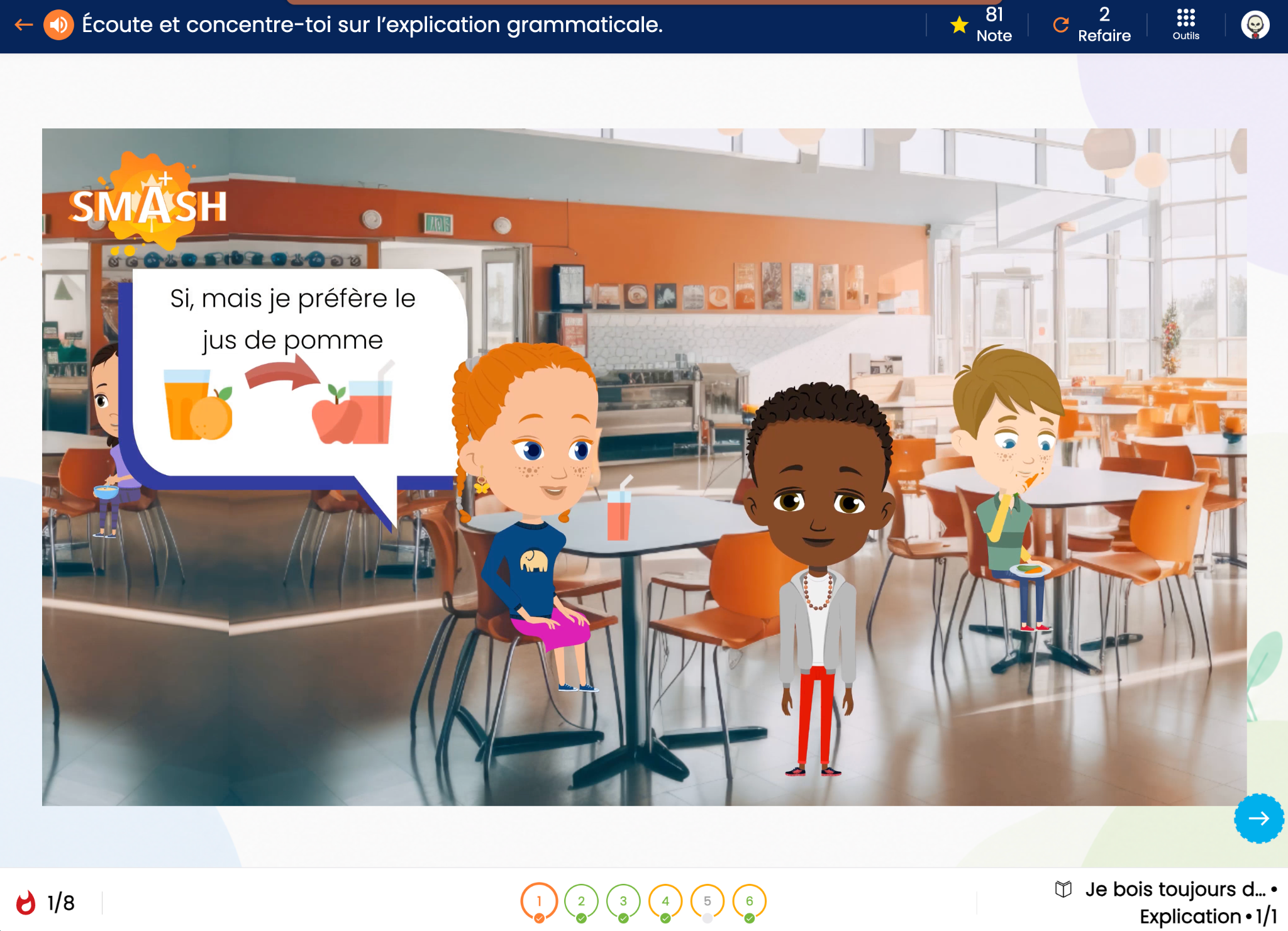
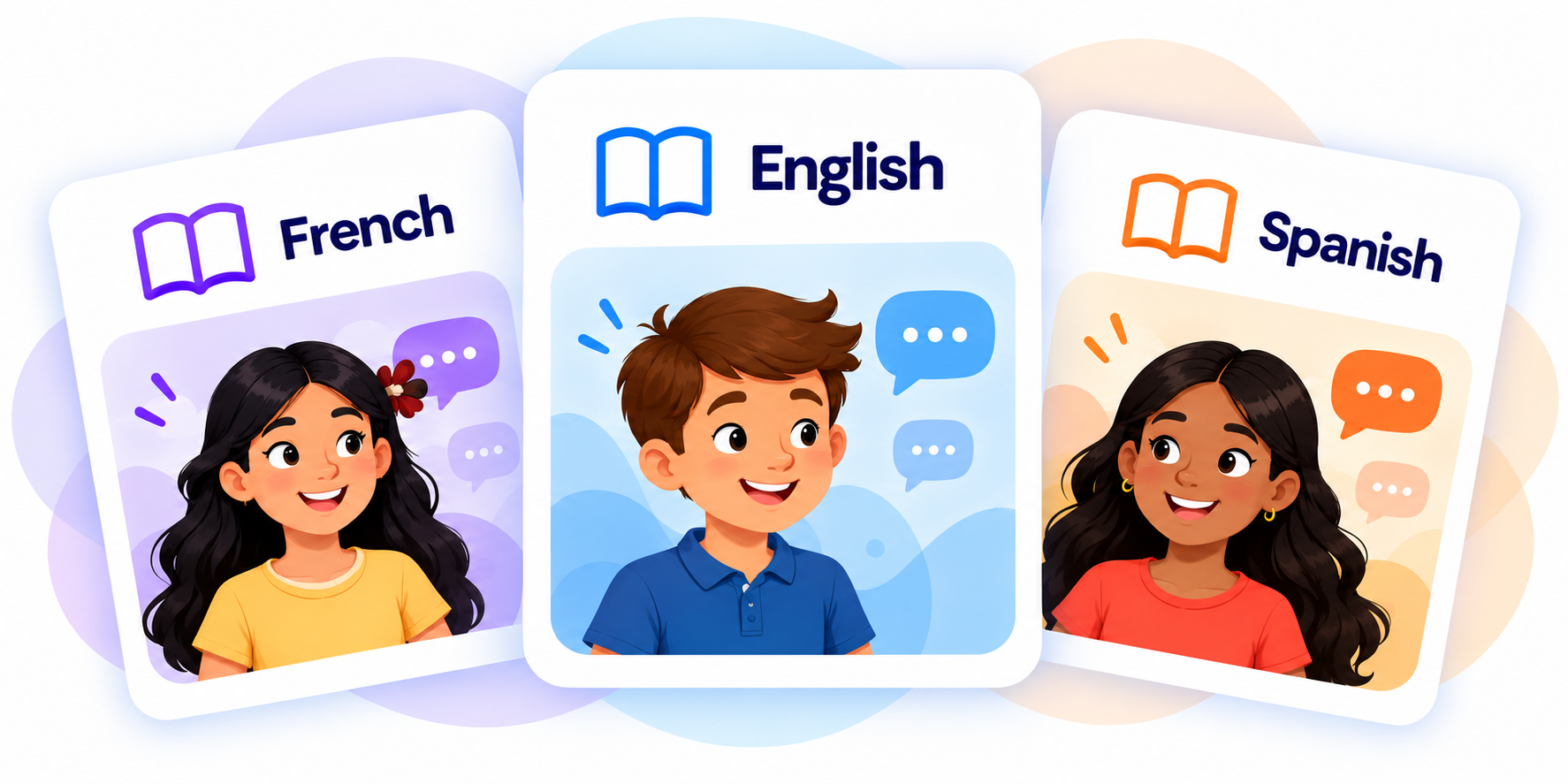
Our content celebrates diversity and presents engaging, real-life situations that help learners see themselves and the world around them in the language they are learning.
Smash brings language learning to life through engaging situations, varied characters and cultural contexts that help more learners connect with what they are learning.

Use Smash in teacher-led lessons, shared-device settings or individual practice. Teachers can also use printable resources when student devices are limited or when offline activities are preferred.
Learners can choose from available fonts, including a dyslexia-friendly option, adjust text size and use light or dark display modes to suit their reading preferences.
Explore how Smash fits your teachers, learners and language programs through a supported pilot before making a wider commitment.
Introduce Smash in one eligible school and evaluate its fit with teachers and learners.

Explore Smash within one or more selected French, English or Spanish programs.
Discuss a coordinated pilot across participating schools, with an implementation scope agreed with Smash.
Establish participating schools, language programs and access requirements with Smash.
Where provided under your district-wide licence, share the teacher registration code with authorized teachers. It is for teacher account creation, not student login.
Use a supported browser, with training, tutorials and direct assistance available. Nothing to install.
Use reports, feedback and conversations with your District Success Partner to guide next steps.
INDIVIDUAL SCHOOL LEVEL
FOR SCHOOL PRINCIPALS & LANGUAGE LEADERS
Give your school a complete, flexible French, English and Spanish learning solution—with ready-to-teach lessons, ongoing teacher support and clearer visibility into student progress.
Structured, engaging lessons and activities for French, English and Spanish.
Support different proficiency levels and learning needs within the same classroom.
Help teachers get started and stay confident with practical training and accessible support.
Review classroom activity, learner progress and teacher adoption within your school.

EXPLORE WHAT MATTERS TO YOU
Everything you need to help your teaching team deliver a successful language program in your school.
Smash helps teachers teach with confidence through ready-to-use lessons, practical onboarding, ongoing support and differentiated learning.
Structured French, English and Spanish lessons and activities that reduce preparation time.
Straightforward account setup and training to help your teaching team get started.
In-platform tutorials and direct live chat help teachers find answers and keep moving.
Built-in activities and differentiated practice help teachers focus on their students.

FLEXIBLE LEARNING
Whether teachers use Smash as a complete curriculum or alongside their existing lessons, it adapts to different classroom setups and learner needs.

Use ready-to-teach lessons to guide whole-class instruction, introduce language concepts and practise together.
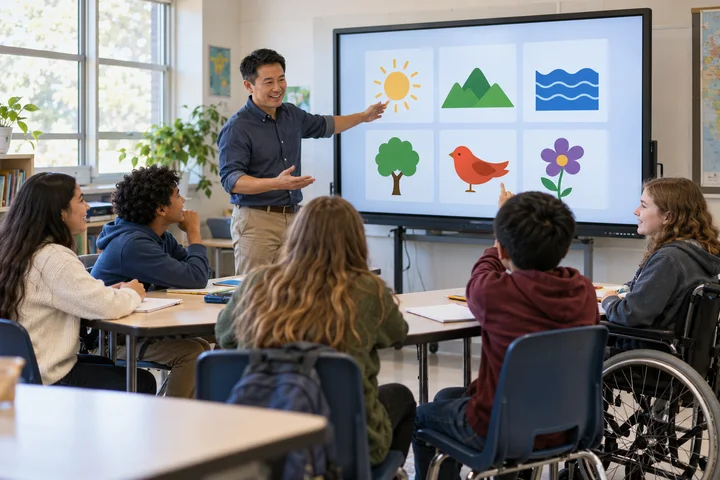
Use Smash during classroom rotations to provide targeted practice while teachers work with other students.

Give students opportunities to practise at an appropriate level and pace through structured digital activities.

REPORTS & VISIBILITY
Understand how Smash is being used across your school and explore student learning progress, from school-level summaries to individual classroom insights.
See usage by teacher, class and student to understand participation across your school.
Review teacher and classroom activity to identify where additional support may help.
Explore available student results and progress by language skill, from school-level summaries to individual learners.
Access class and individual student reports to understand performance, identify strengths and guide next steps.
CURRICULUM ALIGNMENT
Give your teachers structured French, English and Spanish lessons while allowing them to adapt learning activities to your school's curriculum priorities and students' needs.

Give teachers access to ready-to-teach French, English and Spanish lessons that provide structure, continuity and clear learning progression.
Support your school's teaching priorities by reorganizing existing lessons and activities to reflect local curriculum requirements and classroom goals.
Connected lessons link vocabulary, applied grammar and meaningful communication within each theme, with listening, speaking, reading and writing throughout.
SCHOOL PILOTS
Experience Smash with your own teachers and students. Explore how it fits your language program, with onboarding, training and ongoing support before deciding whether to move forward.
Give your teachers and students the opportunity to explore Smash through everyday classroom activities and real language-learning experiences.

Start with practical onboarding and teacher training, then access tutorials, guidance and ongoing support throughout your pilot.
Review teacher participation, student activity and available progress reports to help determine whether Smash is the right fit for your school.
FOR CLASSROOM TEACHERS
Help every student build real communication skills with ready-to-teach French, English and Spanish lessons, differentiated practice and more opportunities to speak—all while saving valuable preparation time.
Structured lessons and activities that reduce preparation time.
Support mixed-ability classrooms with practice suited to different learning needs.
Help students develop oral communication through guided practice and real-life situations.
Review student results, language skills and completed activities to guide next steps.
Explore structured lessons, assign activities and organize learning for your classroom.
EXPLORE WHAT MATTERS TO YOU
Discover how Smash helps you plan, teach, differentiate and track language learning.
WHY SMASH WORKS
Smash connects vocabulary, applied grammar and communication within a shared theme. Clear instruction, differentiated practice and meaningful tasks help teachers support different levels while listening, speaking, reading and writing develop throughout.

BUILD
Build useful vocabulary around the theme.
PRACTISE
Practise applied grammar using the words and expressions just introduced.
COMMUNICATE
See a level-appropriate video conversation, then use the language in action-oriented tasks.
A clear, step-by-step progression from foundational language skills to meaningful communication.
Support students at different proficiency levels with flexible practice and learning pathways.
Give students more opportunities to listen, speak, practise pronunciation and communicate with confidence.
READY-TO-TEACH CURRICULUM
Access structured lessons, engaging activities and classroom resources that help you teach with confidence—all in one platform.
Clear learning objectives and connected activities from one stage to the next.
Meaningful contexts, cultural content and opportunities to practise language.
Follow complete pathways or select lessons and activities for your classroom.
Resources and differentiated practice for varied proficiency levels and learning needs.

Structured French lessons for Core French, world-language and other FSL/FLE classroom contexts.

Progressive English-language learning for multilingual learners, including newcomers developing classroom communication skills.

Structured Spanish lessons that develop language skills through engaging practice and real-world communication.
FLEXIBLE TEACHING
Smash adapts to your classroom—whether you're teaching the whole class, working with small groups or assigning independent practice.
Introduce concepts and guide students through lessons and activities together.
Incorporate Smash into small-group activities and classroom rotations.
Assign structured practice students can complete at their own pace.
Follow a complete learning pathway or select lessons and activities to complement your existing program.

Use Smash with your existing devices and classroom routines.
Adapt activities and learning pathways to different proficiency levels.
Choose from structured lessons, practice and enrichment resources.
Spend less time preparing and more time supporting your students.
ASSESSMENT & PROGRESS
From placement assessments to detailed student reports, Smash helps you understand how learners are progressing, identify areas that need attention and plan your next steps.
Use diagnostic and placement assessments to better understand students' proficiency levels and guide appropriate learning pathways.
Explore student performance across available language skills, activity results and completed learning missions.
Use student results and classroom observations to plan targeted practice, reinforcement or additional challenges.
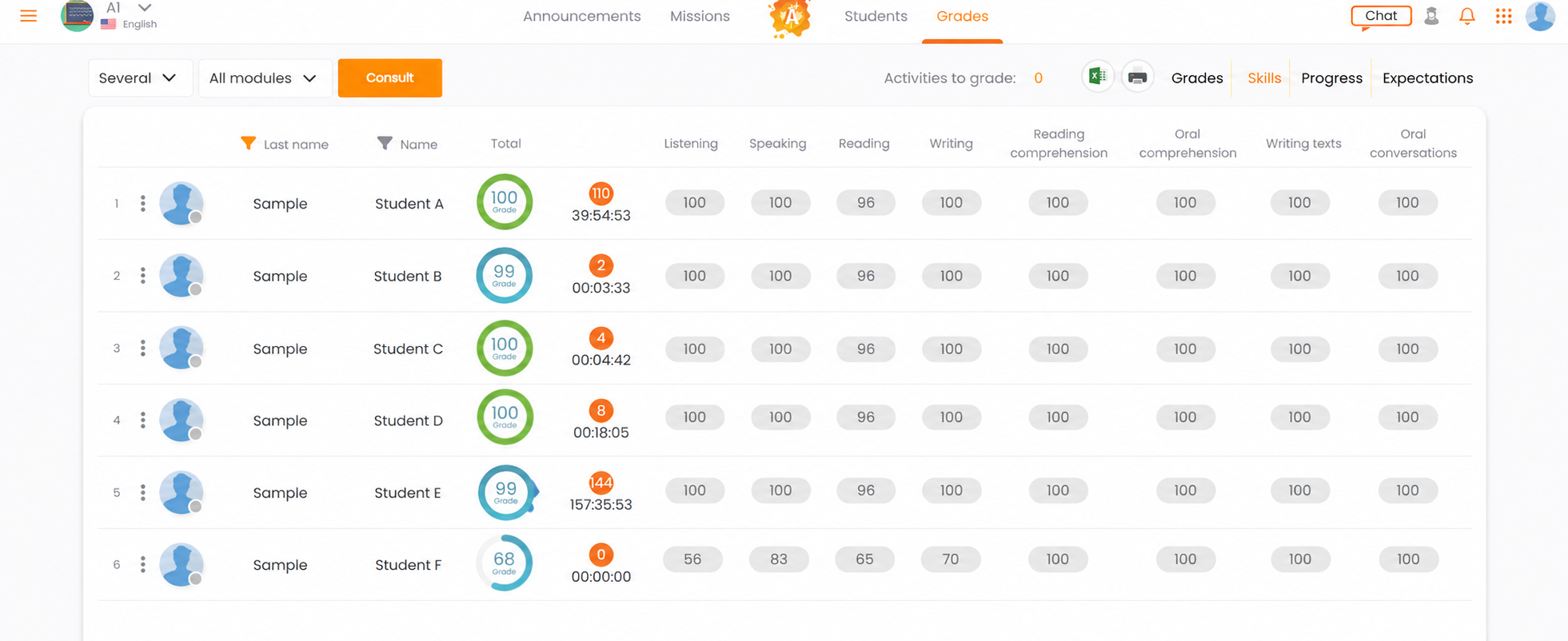
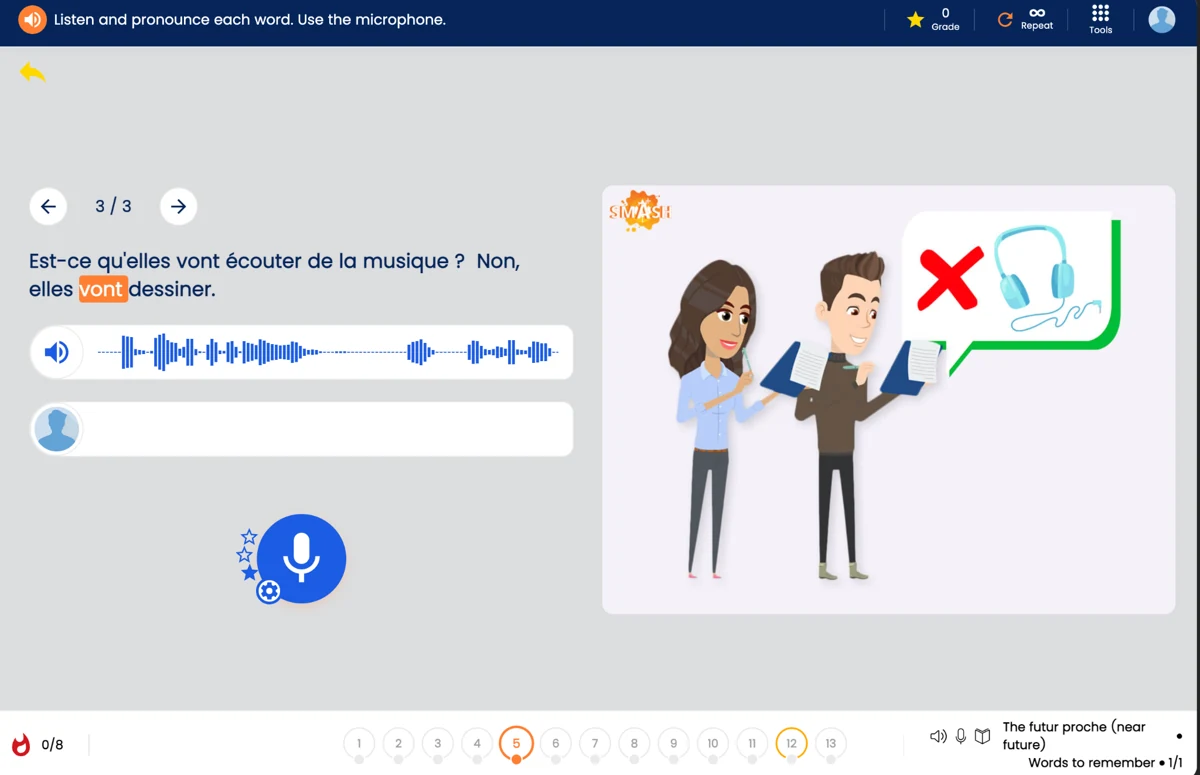
Automatically assessed activities give students immediate feedback as they develop and practise key language skills.
Teachers evaluate written responses, oral tasks and other action-oriented activities that require professional judgment.
TRY SMASH
Explore Smash lessons, interactive activities and sample reports to discover how structured language learning can work in your classroom.
Our team can help you explore demonstration and classroom access options.
Discuss the demonstration and access options with the Smash team.
Discover authentic content from Smash’s language programs.
Explore how the resources can support your teaching routines.
WHY SCHOOLS CHOOSE SMASH
Give teachers a connected path to language learning, with the flexibility to support every student and build real communication skills.
01 / CURRICULUM
Connected lessons build vocabulary, applied grammar and communication skills through a clear learning progression.
02 / DIFFERENTIATION
Adapt instruction and practice to different proficiency levels, all within the same classroom.
03 / COMMUNICATION
Help students develop confidence through pronunciation practice, guided conversations and meaningful real-life tasks.
Identify each learner’s starting point.
Help learners improve as they practise.
Review progress, skills and activity results.
Apply language in meaningful situations.
Immediate feedback applies to automatically assessed activities. Teachers evaluate work that requires professional judgment.
THREE LANGUAGES. COMPLETE LEARNING PATHWAYS.
Choose the pathways that fit your school’s language program, learners’ proficiency and academic priorities.
Complete French curriculum pathways, differentiated practice and enrichment resources for a variety of school programs.
Structured French instruction and practice for Core French, world-language and FSL/FLE classrooms.
Choose Ontario Core French where that documented curriculum fits your school, or select CEFR-based elementary and secondary pathways for proficiency development in Canadian, U.S. and international language classrooms.
Targeted French-language practice and enrichment to complement immersion instruction.
Elementary and secondary CEFR pathways provide scaffolded language practice at different proficiency levels. DELF Prim practice is available for younger learners where relevant.
Progressive practice supporting oral communication, language development and differentiated learning.
Use relevant CEFR-based content alongside your Extended French program. Teachers select activities and proficiency levels to match learners’ needs and local program goals.
Flexible resources for Canadian, U.S. and international French-language learning contexts.
Explore CEFR elementary and secondary pathways for FSL/FLE settings. French ILSS – Paliers supports secondary newcomers learning French in Québec.
These cards describe school program models and teaching contexts, rather than a separate dedicated Smash curriculum for each model. Teachers select from existing curriculum pathways and resources; immersion support does not imply subject-area curricula taught in French.
CURRICULUM PATHWAYS
Ready-to-teach lessons, differentiated practice and a connected progression from foundational language skills to meaningful communication.
Complete, ready-to-teach French curricula, plus supplemental and enrichment resources. Select a pathway for your learners and use it within Core French, world-language teaching, immersion, Extended French or other FSL/FLE contexts.
The elementary and secondary CEFR pathways can also support French Immersion and FSL programs that do not follow a Core French pathway.
BUILT ON RECOGNIZED FRAMEWORKS
The CEFR describes what learners can do with a language. Smash offers CEFR-based programs in French, English and Spanish, including levels A1, A2, B1 and B2.
Official CEFR informationSmash includes DELF and DELF Prim practice to help learners work toward a recognized French-language credential. DELF Prim is the version designed for children.
Smash supports practice and preparation. Official examinations and diplomas are administered separately.
Official DELF informationOfficial DELF Prim informationConnect vocabulary, applied grammar and communication through themed English lessons that build confidence and independence.
Second- and additional-language classes, enriched English and newcomer support.
Select and organise content around provincial, state or national standards and school goals.
Connected lessons, structured progression and differentiated practice across four skills.
Build language and subject understanding through reading, mathematics and science.
CURRICULUM PATHWAYS
Follow a connected pathway or select resources to complement your existing English program.
Connect vocabulary, applied grammar and communication through themed English lessons that build confidence and independence.
FRAMEWORKS & CURRICULUM FLEXIBILITY
Select and organise existing Smash content around your school’s learning goals, learners’ needs and applicable provincial, state or national standards.
The CEFR describes what learners can do with a language. Smash offers CEFR-based programs in French, English and Spanish, including levels A1, A2, B1 and B2.
Official CEFR informationTeachers can select and organise Smash’s existing lessons and resources around applicable learning standards, local program goals and learners’ needs. The content selected and how it is used depend on the teaching context and program priorities.
Bring Spanish to life through connected vocabulary, applied grammar and communication, from first words to purposeful language use.
Support beginners, heritage learners and students in dual-language settings, with differentiated practice for different starting points.
Select and organise content around provincial, state or national standards and your school’s learning goals.
Develop listening, speaking, reading and writing through connected, age-appropriate lessons and CEFR-based progression.
Build Spanish and subject understanding through reading, mathematics and science resources.
CURRICULUM PATHWAYS
Follow a connected Spanish-learning pathway or select resources to complement your existing program.
Bring Spanish to life through connected vocabulary, applied grammar and communication, from first words to purposeful language use.
FRAMEWORKS & CURRICULUM FLEXIBILITY
Follow CEFR-based language progression and select existing Smash content to support your school’s curriculum priorities.
The CEFR describes what learners can do with a language. Smash offers CEFR-based programs in French, English and Spanish, including levels A1, A2, B1 and B2.
Official CEFR informationTeachers can select and organise Smash’s existing Spanish lessons and resources around applicable provincial, state or national learning standards, school program goals and learners’ needs.
DELE is an official Spanish-language diploma. Smash includes practice to help learners become familiar with the language skills used in DELE assessments and work toward a recognized credential.
Smash supports practice and preparation. Official examinations and diplomas are administered separately.
Official DELE informationThe Common European Framework of Reference for Languages describes proficiency through what learners can do. Smash offers CEFR programs in French, English and Spanish, helping you connect teaching goals with practical communication skills.
The CEFR also uses “can-do” descriptors: both approaches focus on what learners can accomplish with a language. This shared focus on practical communication offers a familiar starting point for US educators exploring Smash’s CEFR-based programs. Each framework has its own proficiency structure.
The CEFR describes what learners can do with a language. Smash’s CEFR-based pathways include A1, A2, B1 and B2 content where available in the selected language and program. Use communication goals alongside local curriculum requirements, and confirm the actual coverage of your chosen Smash program.
THE SMASH APPROACH
Vocabulary, applied grammar and communication connect within a shared theme.

01 / VOCABULARY
Learn useful words and expressions through visuals, listening models and interactive practice connected to the theme.
02 / APPLIED GRAMMAR
Practise grammar using the vocabulary you have learned, with sentence patterns that fit the theme and situations you could encounter.
03 / COMMUNICATION
See the theme’s vocabulary and applied grammar come together in a level-appropriate situational video. Then use the language for a meaningful purpose in written and oral action-oriented tasks.
Four interconnected language skills, developed throughout the learning journey.
A CLOSER LOOK AT CONNECTED LEARNING
From the first starting point to the next assignment, Smash helps teachers see where learners are, differentiate practice and understand progress—all in one place.
01 / KNOW WHERE TO BEGIN
Use diagnostic and placement assessments to identify each learner's starting point and plan next steps.
02 / TEACH AT THE RIGHT LEVEL
Assign flexible practice to the whole class, groups or individual learners—all within the same classroom.
03 / UNDERSTAND PROGRESS
Access detailed reports on student progress, skills and activity results to support informed instruction.
Explore connected lessons, differentiated practice and additional resources—all in one place.
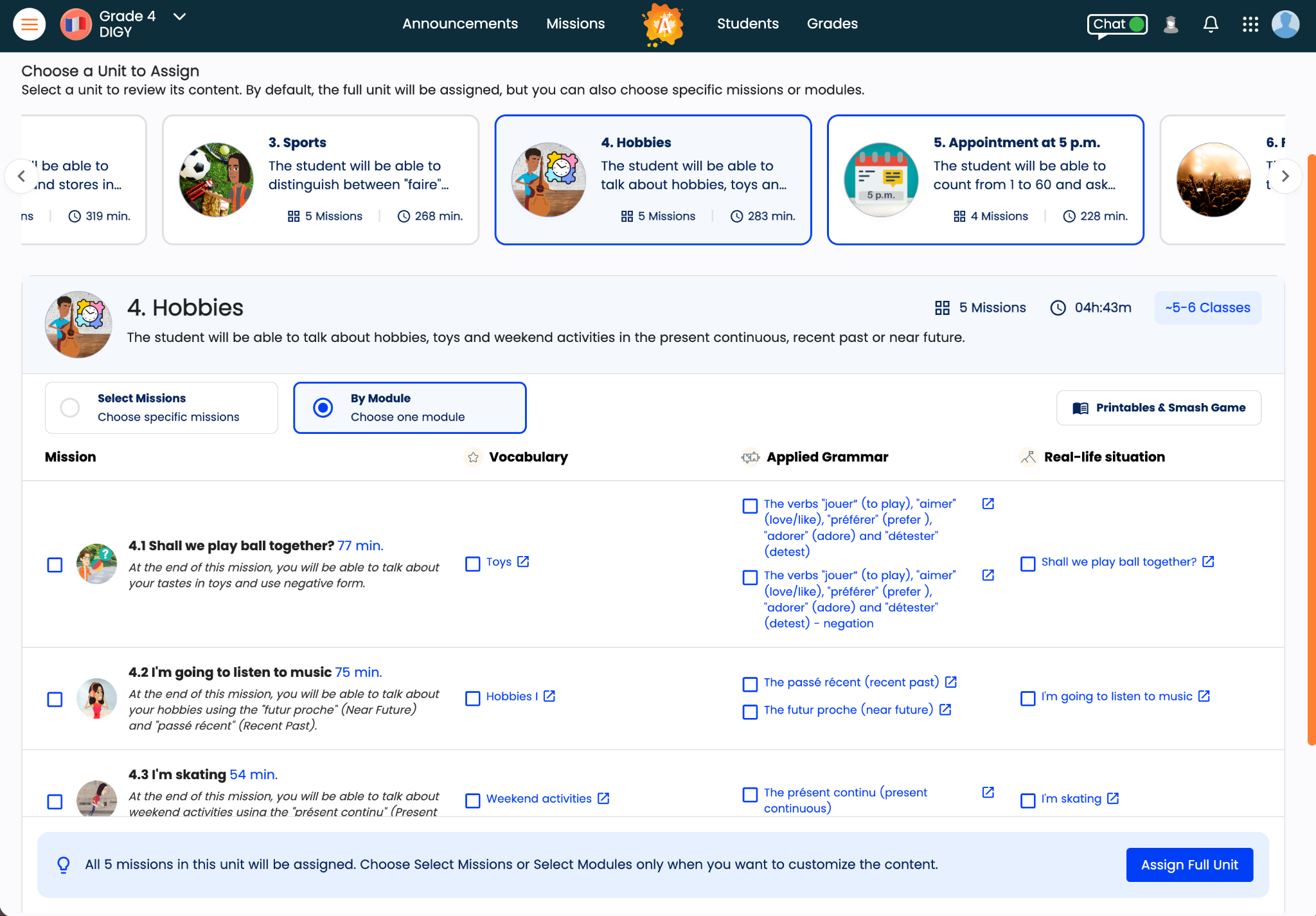
Use ready-to-teach audiovisual content, printables and interactive activities. Select a full unit or specific missions and modules; set mission start dates, due dates and future release to organize practice in class and at home.
Native-speaker audio and pronunciation feedback support practice. Guided conversations and role-play scaffold a path toward more independent communication.
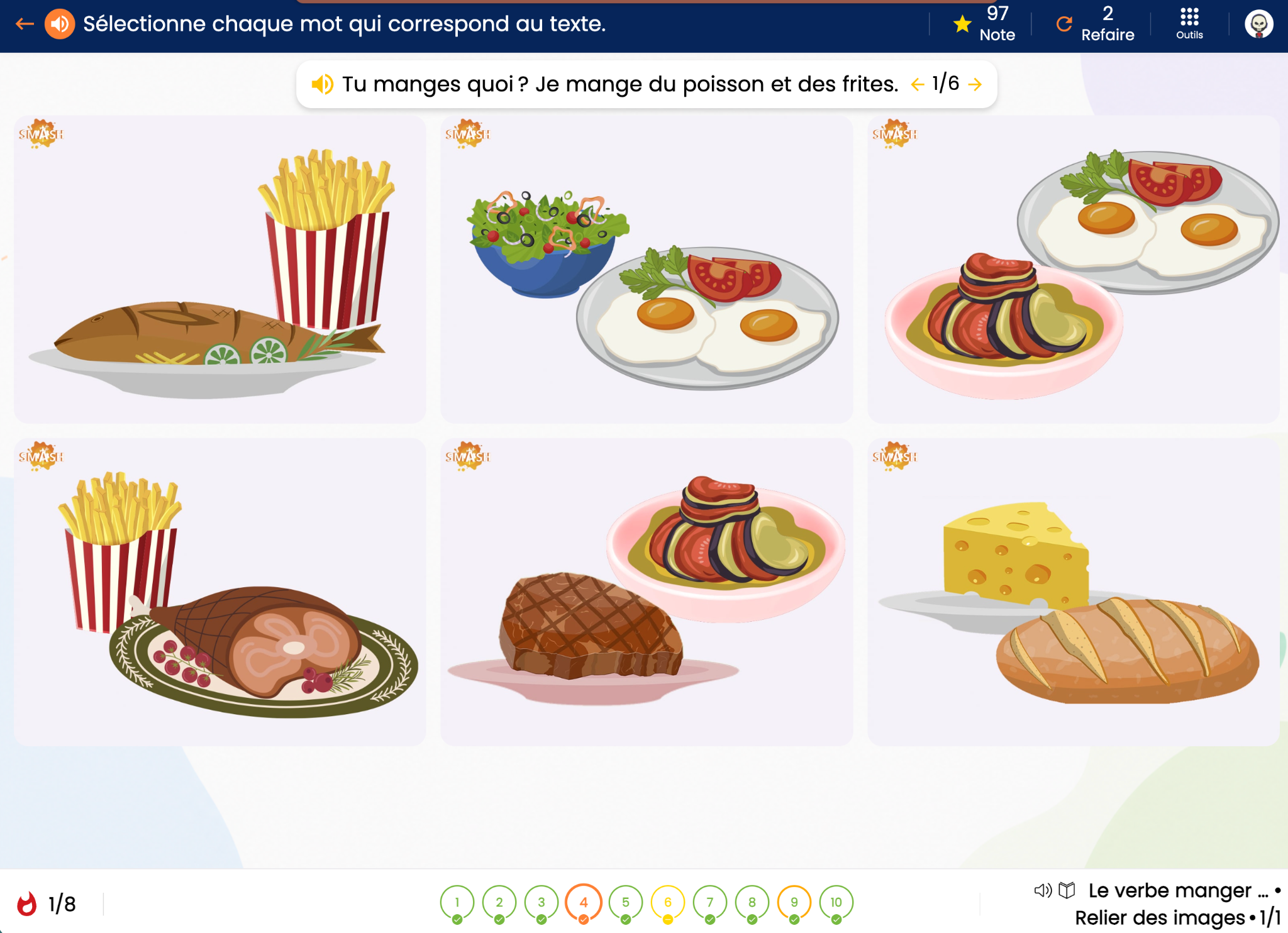
Real examples from different elementary French lessons. These show selected activities, not one continuous lesson.
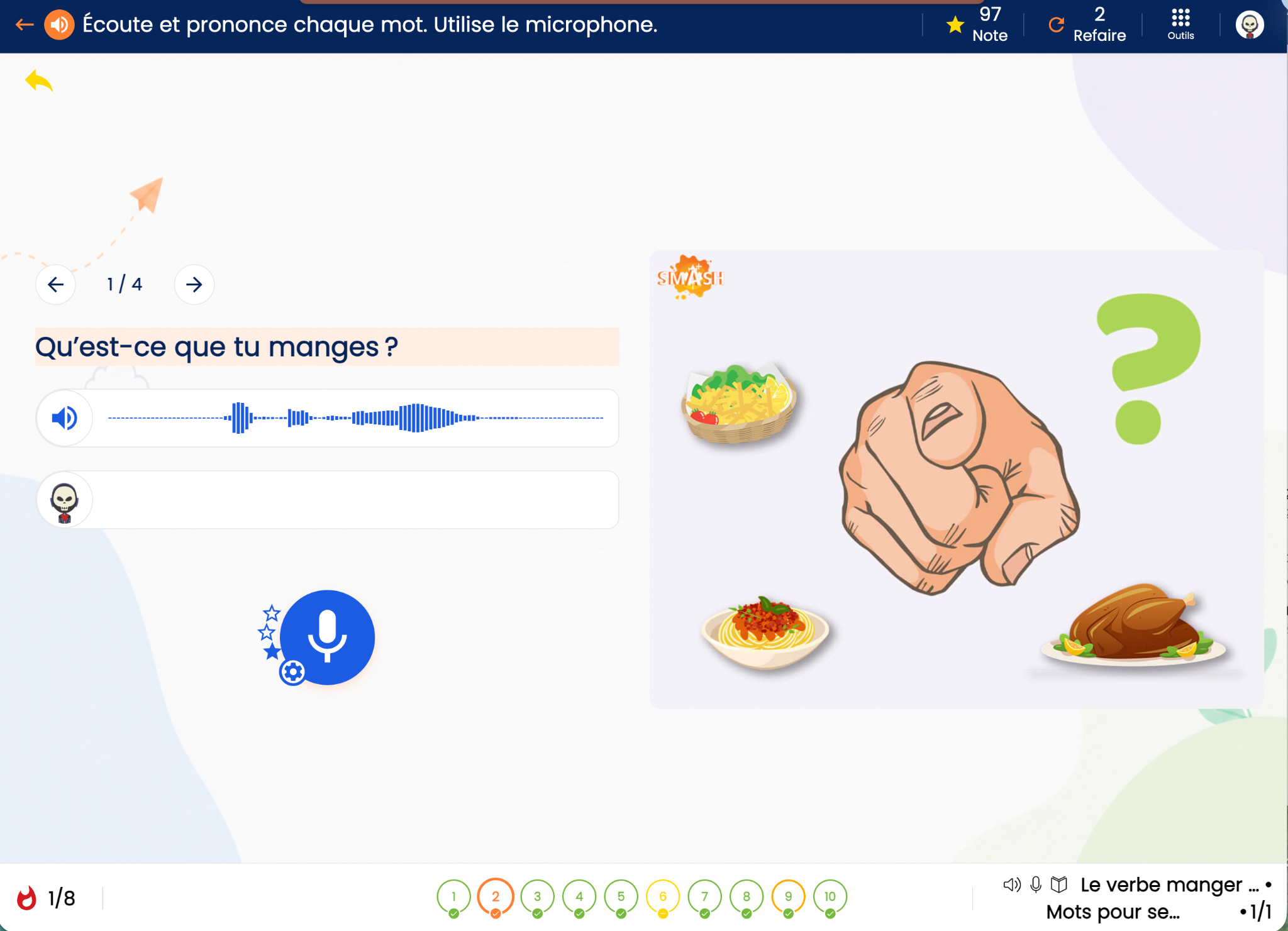
Pronunciation practice and listening models help learners build foundational skills. Action-oriented speaking tasks let learners apply them. Recorded oral responses requiring professional judgment are evaluated by teachers—not automatically graded.
Students build vocabulary around a theme and practise applied grammar with those words. A level-appropriate situational video models the language in a natural conversation; action-oriented tasks invite students to use it for a meaningful purpose.
Automatically assessed activities provide immediate feedback as learners practise. Teachers evaluate action-oriented tasks and other responses that require professional judgment. Automatic feedback reduces routine grading; it does not replace teacher assessment.
Review student progress, grades, language skills and platform usage, alongside written responses and recorded oral work. Use the information to plan targeted instruction, reinforcement or extension.
Existing English-language overview. Press play to watch.
From assessment to practice to reporting, Smash brings it all together in one easy-to-use platform.
IMPLEMENTATION & SUPPORT
A straightforward start, with guidance and support to help your school or district introduce Smash with confidence.
ONE PLATFORM. DIFFERENT CLASSROOM REALITIES.
Use Smash in the way that works for your students, available devices and classroom routines.
Guide the class together using structured lessons and interactive activities.
Provide targeted practice while working with other students.
Give students opportunities to practise at an appropriate level and pace.
Use shared devices or display lessons when individual devices are limited.
YOUR TEACHERS AREN'T ON THEIR OWN.
From initial onboarding to everyday classroom questions, Smash provides practical resources and access to support that help teachers use the platform with confidence.
Practical training to help your team get started.
Step-by-step tutorials available in the Teacher Portal.
Teachers can reach the Smash team through in-platform live chat.
PRICING & ACCESS
Start with the learners you have in mind. Choose the right scale for your language programs and grow with confidence.
International pricing · USD
For a class, a small group or a defined number of learners.
For schools purchasing access for multiple classes or language programs.
For coordinated implementation across participating schools.
Smash plans bring together curriculum, teaching tools, oral practice and reporting. Final program access, licence quantities, support, billing, applicable taxes are confirmed in your agreement. Teacher licences always accompany student licences. They are not sold on their own. Administrative portal access included for authorized board, district or division staff
The applicable market is confirmed using the billing or organisation information normally required for your proposal or purchase. Canadian pricing is for purchases for use in Canada.
Subscriptions do not renew automatically.
BEFORE YOU CHOOSE
Clear answers about curriculum, teaching, access and bringing Smash to your school.
Smash supports French, English and Spanish language education for elementary and secondary learners, including Core French, French Immersion, FSL/FLE, English language learners and Spanish world-language programs. Each language has distinct pathways and resources.
Choose content for learners’ proficiency and classroom needs, then review the relevant sequence against your school’s curriculum priorities.
Explore language programsFrench options include Ontario Core French, CEFR/DELF Prim for elementary learners, CEFR Secondary and ILSS–Paliers for secondary newcomers in Québec. CEFR-based pathways can support French Immersion, Extended French and other FSL/FLE contexts according to proficiency and program needs.
Smash can strengthen language instruction and practice in immersion; it does not replace all subject teaching delivered in French.
Explore French programsEnglish combines elementary and secondary CEFR pathways, KODA Literacy and reading resources with opportunities to develop academic English. Elementary-level mathematics and science content can support elementary English-speaking students, elementary English-language learners and secondary learners developing academic English.
Teachers select resources according to proficiency, literacy needs and classroom goals. STEPS Kids and STEPS Secondary are also available where relevant.
Explore English programsSpanish includes elementary and secondary CEFR pathways, advanced/AP resources where relevant, Hispanic culture and communication activities. Teachers can select content for world-language, heritage-learner and supported dual-language contexts. Reading, mathematics and science resources offer additional academic-content practice.
Choose the sequence and resources for each group’s proficiency and goals; availability depends on the selected program.
Explore Spanish programsYes. Smash’s English and Spanish curricula, together with supplementary and enrichment resources in both languages, have been used in combination to support English–Spanish dual-language programs in the past.
Schools exploring dual-language immersion (DLI) or two-way immersion can select and organise existing Smash content to support language development, literacy and academic vocabulary in English and Spanish. Teachers choose the resources and sequence according to learners’ proficiency, the school’s language allocation and local curriculum priorities.
Contact our team to explore a combination of English and Spanish resources for your program.
Explore English and Spanish programsLanguages vary from place to place, and learning those differences is part of communicating confidently. Smash introduces learners to different accents and regional vocabulary in French, English, and Spanish—for example, French words used in both France and Quebec.
This exposure helps learners understand a wider range of speakers and recognize how the same idea can be expressed in different ways.
Both. Teachers can assign short, targeted activities for classroom practice, homework, workshops or specific learning needs. Some focused activities may take around 5–10 minutes, depending on the activity and learner. Smash also provides complete curricula organized by grade or proficiency level, with connected units and learning missions.
Vocabulary, applied grammar and communication develop together, with listening, speaking, reading and writing integrated throughout the progression. Educators can follow the main pathway or select practice within that structure. Lasting language proficiency develops through ongoing practice and opportunities to apply what has been learned.
Explore the curriculum and lessonsSmash offers structured curricula, including Ontario Core French and CEFR-based French, English and Spanish pathways. Teachers can select and reorganize existing lessons for provincial, state or local curriculum priorities. Start with the relevant program and sample lessons, then identify content that supports your required learning objectives.
This is a review of existing content, rather than automatic standards mapping.
See the shared focus on communicationReview the relevant program, sample lessons, diagnostic or placement results and communication goals with Smash. Your educators choose the content and assignments that fit their course or school requirements.
Smash Education develops and maintains its French, English and Spanish curricula. The approach combines purposeful lesson sequences, vocabulary and applied grammar, meaningful communication activities and resources for learners at different starting points.
Lessons and activities are refined and updated over time, while educators choose the content and practice that fit their learners.
Meet Smash EducationProgress depends on students’ starting points, ages, previous learning, instructional time and opportunities to use the language. Students in the same class may develop different skills at different rates.
Smash’s structured pathways provide a reference for learning progression, while teachers set goals appropriate to their students and curriculum. CEFR levels should not be treated as fixed timelines or automatic equivalents to school grades.
Not necessarily. Students who already know some of the language may be ready to begin beyond the introductory levels. The right starting point depends on what they can understand and do, rather than which courses they have completed.
However, moving ahead before they are ready can leave gaps that make later learning harder. Teachers can build on students’ existing strengths, revisit foundations where needed, and work toward increasingly demanding tasks. Students may also be stronger in some skills than others. Available levels depend on the selected language and program.
Build regular, focused practice into lessons and independent work. Choose a routine that fits students’ ages, schedules and learning goals. Short activities reinforce earlier learning; sustained practice gives students time to listen again, understand a sentence pattern and build a response.
Smash connects vocabulary, applied grammar and communication through structured lessons across listening, speaking, reading and writing. The aim is to move beyond recognizing words toward understanding others and expressing ideas in the language being learned. Teachers can revisit foundations, use feedback and choose opportunities for students to apply something new within their existing teaching context.
Progress can feel less noticeable when familiar conversations become manageable but longer speech, unfamiliar topics and more complex language still require effort. This is sometimes called an “intermediate plateau” or “B1 plateau”; it does not mean learning has stopped.
Smash combines scaffolded immersion, natural-speed speech and vocabulary and applied grammar practice within connected themes. Repeated practice helps learners connect ideas, choose language more precisely and respond more independently as they work toward B2, where offered.
Smash uses CEFR-based pathways to give learners and educators a structured reference for progression and communication goals. The Common European Framework of Reference for Languages (CEFR), developed by the Council of Europe, describes practical language abilities through “can-do” statements.
This shared reference works across languages and educational settings; activities and expectations still need to suit learners’ ages, goals and contexts. Explore the Council of Europe’s official CEFR overview and language proficiency descriptors.
Yes—compare shared language-learning goals. Smash’s CEFR-based pathways provide a structured reference for developing French, English and Spanish skills. Educators can compare learning objectives and identify relevant content, even when their local curriculum uses a different structure.
Developed by the Council of Europe, CEFR describes what learners can understand and do in a language. It also provides a reference for qualifications offered by Cambridge English, France Éducation international and Instituto Cervantes.
Review Smash’s pathways alongside your school’s requirements to identify support for instruction and practice. The fit depends on the language, available levels, learner needs and local objectives. These institutional references explain frameworks and qualifications; they do not certify Smash or establish automatic curriculum alignment or exam-preparation services.
Official references by language
For educators considering ACTFL goals, Smash’s CEFR-based pathways offer a reference for discussing language progression. Both frameworks describe what learners can do, but their levels and assessment systems differ.
ACTFL (American Council on the Teaching of Foreign Languages) worked with a European research group on linking and validation studies. Its official CEFR alignment page explains the assessment-specific findings.
What should educators keep in mind?
Smash’s CEFR-based pathways can help teachers describe newcomer students’ English or French development and set communication goals alongside their school requirements.
For school-age newcomers, consider provincial or territorial curricula, previous schooling, literacy backgrounds and classroom language needs. CEFR levels do not automatically correspond to grades or provincial assessment levels.
CMEC’s guidance on CEFR in Canada provides context. Ontario’s French as a Second Language curriculum and Alberta’s K–12 English as an Additional Language Proficiency Benchmarks are provincial examples, rather than evidence of identical practices across Canada. Review Smash’s available content against your setting’s goals.
Yes. Official education documents in countries such as Mexico, Colombia and Chile reference CEFR when describing language-learning goals or proficiency. In Spanish, CEFR is known as MCER—Marco Común Europeo de Referencia para las Lenguas.
Mexico’s SEP CENNI documentation includes framework references. Colombia’s Ministry of National Education English-language competency standards (PDF) and Chile’s Ministry of Education English curriculum document (PDF) reference CEFR in English-language education.
These examples explain the relevance of CEFR-based pathways in the region. Requirements vary by country, institution, program and learner age. For K–12 schools, universities and adult learners reviewing Smash, CEFR provides a common reference for progression while local curriculum and certification requirements remain in view.
The Council of Europe’s official CEFR overview explains the shared framework behind these references.
Smash’s CEFR-based French pathways provide a reference for learning goals alongside official French qualifications. DELF covers A1, A2, B1 and B2; DALF is a separate diploma for more advanced proficiency, beyond Smash’s stated scope.
Earning either diploma requires passing its official examination separately. Completing a Smash level does not award a diploma or guarantee exam success. France Éducation international: Official French-language diplomas and tests explains the qualifications.
Smash’s English pathways and Cambridge English Qualifications both use CEFR as a reference for progression. This helps schools in Mexico and elsewhere discuss language goals using a shared framework.
Cambridge English Qualifications include A2 Key, B1 Preliminary and B2 First, with qualifications for young learners and school-age versions. These English-language qualifications are distinct from Cambridge International school curricula.
Smash supports learning over time; a Cambridge exam assesses performance against its own requirements. Sharing CEFR levels does not establish identical content or exam readiness, and completing a Smash level does not award a qualification or guarantee an exam result. See Cambridge English: CEFR and international language standards.
Teachers can use diagnostic and placement results to identify learner starting points and differentiate instruction. Follow the main curriculum for whole-class teaching, then choose supplementary materials to reinforce skills, address gaps or extend learning. Scaffolded activities and detailed reports help guide those choices.
Explore differentiation and learner progressSchools and districts have shared positive feedback about using Smash with autistic students, students who are hard of hearing, and students with speech or articulation difficulties.
Structured, sequenced learning can support a familiar routine, while differentiated content supports different language levels. Educators also report that some students with speech or articulation difficulties appreciate oral practice without feeling repeatedly penalized for their speaking differences.
Suitability depends on the learner, activities and support available; adaptations may be needed. Smash is not a specialist intervention or speech therapy tool.
Contact us to discuss your students’ needs and explore whether Smash would be a suitable fit.Yes. Teachers can preview lessons and activities, then choose assignments for a class, flexible group or individual learner. Students in the same class can receive different practice, reinforcement or enrichment according to proficiency, placement information and teacher observations. Teachers retain control of the learning activities they assign.
Implementation & SupportConnected lessons and ready-to-use activities reduce the need to create resources from scratch. Teachers preview the content, choose suitable starting levels and select what to teach or assign. Teacher-led lessons, differentiated practice and printable resources can be combined to fit the class, timetable and school’s teaching approach.
Explore classroom advantagesConnected lessons develop vocabulary and applied grammar through listening, speaking, reading and writing, with guided conversations and action-oriented tasks. Automatically graded activities give immediate feedback, and results are automatically available to teachers without manual correction.
For open-ended written and oral tasks, students use the “Submit to teacher” button in their portal to send work for teacher review. Pronunciation and voice-recognition practice complement this work; automated scoring depends on the activity.
Explore skills practice and progressTeachers can review class and individual learner activity, available results and language-skill information, including written responses and recorded oral work where available. Reports reflect the activities teachers assign and the evidence collected; unassigned skills should not be read as demonstrated mastery.
Login or usage information shows participation, while assessed work and teacher review inform learning decisions.
Explore progress and classroom toolsThe diagnostic and placement test helps teachers identify a starting point and choose suitable practice. It supports instructional decisions. Official DELF and DELE qualifications are awarded through their separate examination processes.
Explore the detailsSmash offers DELF and DELF Prim practice for French, and DELE practice for Spanish. Practice is distinct from taking an official examination and receiving a qualification from the relevant examination body.
Explore the framework & exam practiceAsk to see relevant lessons, activities and progress reports. Discuss how the content fits your teaching plan, mixed-ability groups and use in class or at home.
Explore the teaching solutionBring your learner numbers, program goals, timetable and teacher-support needs. Also discuss devices, accessibility, account setup and any required integrations before selecting a package.
See the review checklistSmash is web-based and needs internet access, a supported browser and a compatible device. The published options include computers, tablets and iPhones. Share your school’s device, browser and network setup with Smash before adoption so the relevant activities can be checked.
Printable resources complement digital lessons; they do not make every activity available offline.
Implementation & SupportNo. Teachers can lead lessons with a projector or interactive whiteboard, use shared devices or organize individual practice in class or at home. Printable resources are another complementary teaching option when devices are limited.
Choose the combination that fits your classroom and confirm the learner accounts and licences required for your implementation.
Discuss your classroom setupSmash is web-based, with no software installation. We offer virtual training for program leads or teaching teams, plus Teacher Portal video tutorials and direct live-chat support. Agree on the arrangements that fit your rollout. Teachers can choose whether to enable direct messaging through Smash, allowing students to contact them within the portal.
Explore getting startedThe current offer is USD $39 per student, per year, for one language (regular price: USD $50). A teacher licence is included with 10 or more student licences. 1–9 student licences: an annual teacher licence is required alongside the student licences. Contact us for pricing. Teacher licences are not sold separately.
Confirm applicable taxes and subscription terms in your proposal.
Explore pricing optionsThe annual school student reference rate covers one language. Confirm the languages, programs and learner numbers in your school or district proposal. Individual home-learning plans are a separate offer.
Explore the detailsNo. Contact us for school-wide pricing; the number of student licences and participating programs is defined by the agreement. Larger-volume purchasing can provide more favourable per-student pricing. Share your learner numbers, languages and program structure so Smash can confirm the access, teacher accounts, support and price appropriate to your school.
Explore licence optionsStandard curriculum and platform updates within your subscribed program are included during an active subscription, unless your plan or agreement specifies otherwise. Separately priced offerings are identified in the applicable offer or agreement.
Yes. Multi-year pricing, duration, access and support are established in your proposal and agreement. Share the participating schools, learner numbers, languages and expected implementation period so Smash can develop an arrangement suited to your plans.
Prices shown use the displayed pricing market and currency. Your proposal confirms the applicable market, billing currency, taxes and agreed licence scope. Smash is a Canadian company and platform access is delivered digitally; ask our team to clarify purchasing requirements before committing.
Explore the relevant detailsSmash does not require student personally identifiable information. Its platform servers are located in Canada.
Read more about Privacy & TrustThe Privacy Policy explains educational data such as activities, progress and oral recordings, technical information needed to operate the platform, and adult account or billing details. It also describes optional identifiers, access, retention and deletion.
Read the Privacy PolicyInstitutional student accounts are deleted each August unless the institution expressly requests that they remain active. Associated content is deleted with the student account. Teachers or administrators can also delete student accounts through their portal within the institution’s permissions. Some information may remain temporarily in backups.
Discuss any records you need and continuation requests before your subscription ends; the Privacy Policy explains retention and deletion.
Privacy & TrustLearners can choose available fonts, including a dyslexia-friendly option, adjust text size and select light or dark display modes. These options help learners tailor the reading display to their preferences. Review relevant activities, devices and assistive-technology needs with Smash when assessing suitability for individual learners.
Explore accessibility and technical reviewYes. Smash is open to partnering with Indigenous communities and organizations to help develop content for language revitalization. We have already collaborated with one group. Each project’s goals, scope and development pricing are discussed individually with the partner.
Explore Indigenous language partnershipsYes. We can discuss a school or program as a starting point and an expansion plan suited to your goals. Scope, access and licensing are agreed with Smash.
Discuss the schools, programs and learners you would like to include. Eligible pilots have no cost and no obligation; eligibility, duration, scope and terms are confirmed by Smash.
District licensing is based on participating schools, student numbers, languages, programs and implementation needs. Larger volumes may support more favourable per-student pricing. The proposal defines the schools, learners, teacher accounts, administrative access and support included. Multi-year pricing and terms can also be established in the agreement.
Sequenced French, English and Spanish pathways give participating schools a shared foundation. Teachers can select and reorganize existing lessons and activities for local priorities and learner needs. Each school reviews the relevant program against its own provincial or state requirements, while retaining control of its teaching sequence.
A district-wide licence normally includes a registration code that authorized teachers use to create their accounts. This code is for teacher registration; students use their own login access. Where a particular implementation requires school-specific codes, those arrangements are agreed with Smash.
Authorized administrators can view district-wide and school-level account and usage information, manage schools, teachers and students within their scope, and review end-of-year survey results and responses. Usage reporting is distinct from individual learner progress and proficiency reporting.
School-level administrative access is scoped to the authorized school. The access appropriate to each administrator is established for your implementation.
Standard district onboarding includes a live virtual kickoff, three scheduled follow-up sessions and a District Success Partner. Teachers also have in-portal tutorials and live chat. Implementation arrangements are confirmed with your team.
LET'S BRING SMASH TO YOUR SCHOOL
Explore how our complete language education solution can support your curriculum, teachers and learners.