Build your language skills.One connected step at a time.
Learn French, English or Spanish for yourself or with your child. Follow structured lessons and regular practice towards more confident, independent communication, at a pace that fits your life—with language coach support and feedback on open-ended activities.
Structured learningConnected lessons. A clear way forward.
A path at your levelStart where you are. Build from there.
More language to useListening, speaking and meaningful practice.
START WITH WHAT MATTERS TO YOU
Who are you learning for?
Your goals. Your routine. A language-learning path with purpose.
Adult learnersBuild useful language skills with a connected path—and more opportunities to practise communication.Explore your learning path
Adult learners
Build French, English or Spanish through connected lessons and purposeful practice. Start with an appropriate pathway and work toward more independent communication.
Parents & caregiversHelp your child practise with purpose, build confidence and get support along the way.Explore learning for your child
Parents & caregivers
Find a pathway for French practice, English learning, Spanish or literacy support. Connected activities help your child build skills rather than jump between unrelated exercises.
Homeschooling familiesBring structured language learning into your home routine, without building a curriculum from scratch.Explore learning at home
Homeschooling families
Use connected lessons and practice to bring language learning into your home routine. Choose an appropriate starting point and revisit skills as needed.
Follow a clear sequence and practice the language out loud. Build useful vocabulary, connect it to sentence patterns and bring it into everyday conversations.
Supporting your child
Give your child a structured path, varied activities and opportunities to speak. Encourage a regular routine, with feedback from your language coach on open-ended work.
Homeschooling
Make language learning part of your week. Use connected lessons, interactive practice and printable resources, with language coach support for questions and open-ended activities.
Learn at your own pace. Build skills that last.
Whether you have a few minutes to practise or more time to explore a lesson, Smash helps you make your learning count. Follow a thoughtfully structured path that builds listening, speaking, reading and writing over time.
Each stage builds on what you know, helping you move from learning new vocabulary and sentence patterns to using the language with greater confidence and independence.
Short sessions can reinforce a skill or help you review. Continued practice and opportunities to use the language support meaningful progress, at a pace that fits your life.
01
Build on what you already know.
Connected lessons guide you from useful words and sentence patterns to conversations. Revisit a skill when you need more practice, then continue along a clear learning path.
02
Practice out loud
Listen to a model, try a guided conversation and put new words into spoken language. Speaking activities and pronunciation feedback give you ways to practise out loud.
03
Keep learning varied
Use audiovisual lessons, interactive activities, games and printable resources to revisit skills in different ways.
French, English or Spanish. Your next language.
Extra practice for school, structured learning at home or a language for yourself. Find the starting point that fits.
Choose a language to explore its pathways.
French
Extra school practice, support for immersion or a language-learning routine at home. Start with the need; we’ll help you find the pathway.
Choose a pathway according to the learner’s age, proficiency and goals. School program names describe learning contexts; review the available language resources for your home-learning needs.
School-age learners
My child needs more French practice.
Follow a sequence that connects with Core French learning at school. Revisit skills and build confidence through regular practice.
About this pathway
Core French is a school pathway based on the Ontario curriculum. Additional French practice can reinforce the skills your child is working on.
Elementary
My child is beginning to use French.
Build useful language step by step, with a structured route to understanding and speaking.
About this pathway
The elementary CEFR pathway uses a shared reference for language proficiency. DELF Prim practice is available for children preparing for that French-language exam.
Elementary and secondary
My child is in French Immersion.
Add structured French practice alongside school learning, with a starting point suited to your child.
About this pathway
Elementary and secondary CEFR pathways can support French Immersion and other French-as-a-second-language settings. The right choice depends on your child’s level and goals.
Secondary / high school
My teen needs a clear path forward.
Use connected lessons and language practice instead of jumping between unrelated exercises.
About this pathway
CEFR Secondary supports a structured progression in French. CEFR describes what a learner can do with a language at different proficiency levels.
Secondary newcomers
We’re settling into school in Québec.
Explore a French pathway designed around the needs of newcomers in Québec.
About this pathway
ILSS stands for linguistic, school and social integration. Its Paliers pathway is relevant to secondary newcomers learning French in Québec.
Individual learners
I’m learning French for myself.
Build a regular learning routine with a structured language sequence and opportunities to practise out loud.
About this pathway
Explore the CEFR-based French sequence and additional practice according to your starting point and goals.
French credentials: DELF and DELF Prim
DELF is an official French-language diploma. It gives learners a recognized way to demonstrate proficiency and a concrete communication goal to work toward. Smash includes DELF practice; DELF Prim practice supports younger learners preparing for the child-focused version.
Smash supports practice and preparation. Official examinations and diplomas are administered separately.
Learning English and learning to read are connected, but they are not the same task. Find language practice and literacy support that match your learner’s needs.
Elementary or secondary
My child is learning English.
Build understanding, speaking, reading and writing with a sequence suited to your child’s stage.
About this pathway
CEFR Elementary and CEFR Secondary offer structured English-language pathways. CEFR is a shared reference for what learners can do with a language.
Elementary or secondary · Ontario
We need English support that fits school.
Explore a pathway that connects English development with the Ontario school context.
About this pathway
STEPS Kids and STEPS Secondary are Ontario-context pathways. We can help you check which one fits your child’s age and learning needs.
Literacy development
My child needs more literacy support.
Make room for focused English literacy practice alongside language learning.
About this pathway
KODA Literacy and additional literacy content can support the skills your learner needs to strengthen. Ask us about the appropriate starting point.
Individual learners
I want to build my own English skills.
Follow a connected language sequence and make useful English practice part of your routine.
About this pathway
Explore CEFR-based English for language learners and additional practice according to your proficiency level.
Spanish
A clear, connected way to learn Spanish—for your child, your teen or yourself. Listen, practise and speak.
Elementary
I’d like my child to learn Spanish.
Begin with connected activities and a clear sequence that helps children start using Spanish.
About this pathway
CEFR Kids is the elementary Spanish pathway. It organizes language development around what learners can understand and do.
Secondary / high school
My teen needs structured Spanish practice.
Support school learning or home study with lessons that build on one another.
About this pathway
CEFR Secondary develops Spanish proficiency through a structured progression and communication-focused practice.
Individual learners
I’m learning Spanish for myself.
Move beyond random exercises with a sequence you can follow and practise regularly.
About this pathway
Explore CEFR-based Spanish and additional practice that match your starting point and goals.
Spanish credentials: DELE
DELE is an official Spanish-language diploma issued by Instituto Cervantes on behalf of Spain’s education ministry. Learners may pursue it to document their language proficiency. Relevant Smash Spanish content includes DELE practice.
Smash supports practice and preparation. Official examinations and diplomas are administered separately.
CEFR is a widely used reference for what a learner can understand and do with a language. It helps organize a clear progression, with a starting point and next steps. You do not need to know your child’s CEFR level before contacting us.
A shared reference. Around the world.
The CEFR describes what learners can do with a language. Smash’s CEFR-based pathways include A1, A2, B1 and B2 content where available in the selected language and program. Use communication goals alongside local curriculum requirements, and confirm the actual coverage of your chosen Smash program.
CEFR and ACTFL both describe what learners can accomplish with a language. That shared focus makes Smash’s communication-based learning relevant to these teaching goals. Their proficiency scales differ; a CEFR level is not an automatic ACTFL rating.
Your goals determine the journey. Consistent, purposeful practice helps you move forward.
How long it takes depends on where you are starting, what you want to achieve, and how regularly you learn and use the language. Managing everyday exchanges is a different goal from following university lectures or communicating confidently at work.
English for everyday life, learning and work.
Build toward goals such as asking for help, following classroom instructions or sharing ideas at work. More demanding academic tasks take sustained practice; useful everyday communication can develop along the way.
Approximate guided learning hours for English
Approximate guided learning hours for English
CEFR level
Approximate cumulative guided learning hours from beginner
A1
90–100
A2
180–200
B1
350–400
B2
500–600
These Cambridge English estimates refer to cumulative hours of lessons and supervised study from beginner level. They are general guidelines, not guaranteed timelines, prescribed hours on Smash, or a school-grade schedule. Individual learners may need more or less time.
French for conversation, community and further study.
Your goal might be joining a conversation, understanding a school message or preparing for further study in French. Build listening and speaking alongside reading and writing, with support appropriate to your starting point. A CEFR level describes language ability, not a fixed course duration.
Spanish for family connections, travel and participation.
Exchanging news with relatives, asking questions while travelling and contributing to a class discussion call for different skills. Regular opportunities to use Spanish help connect what you learn with what matters to you. A CEFR level is not a fixed course duration.
Smash’s structured pathways connect vocabulary, understanding how the language works, and use through listening, speaking, reading and writing. Progress is individual: different skills can develop at different rates, and useful gains happen throughout the journey.
What influences progress?
Starting level and previous language-learning experience.
Regular opportunities to learn and practise.
Teaching, feedback and appropriate support.
Exposure to the language beyond lessons.
Learners’ ages, literacy backgrounds and goals.
Choose a manageable routine that fits your goals and circumstances. Consistency matters; one schedule will not suit everyone.
As language tasks become more demanding, progress can feel less obvious. Revisiting difficult skills, receiving feedback and using the language in varied situations can help learners continue developing.
Available A1, A2, B1 and B2 content varies by language and program. Review the actual coverage of your chosen pathway; completing activities does not automatically establish an independently assessed CEFR level.
Listening, speaking, reading and writing are woven into each stage, with practice suited to your level. Follow a guided path, revisit skills and apply what you learn in context.
01
Learn with a model.
Listen, explore useful words and connect them with sentence patterns.
02
Practise with guidance.
Try interactive listening, reading, writing and speaking activities. Revisit a skill when you need more practice.
03
Put your words to work.
Use guided conversations and oral activities, with feedback from your language coach on open-ended work through your individual plan.
A CLOSER LOOK AT CONNECTED LEARNING
Choose a tab. See one part of the experience at a time.
A clear sequence. One step at a time.
A structured path you can follow at home. Connect useful words and sentence patterns with listening, speaking, reading and writing; revisit a skill when you need more practice.
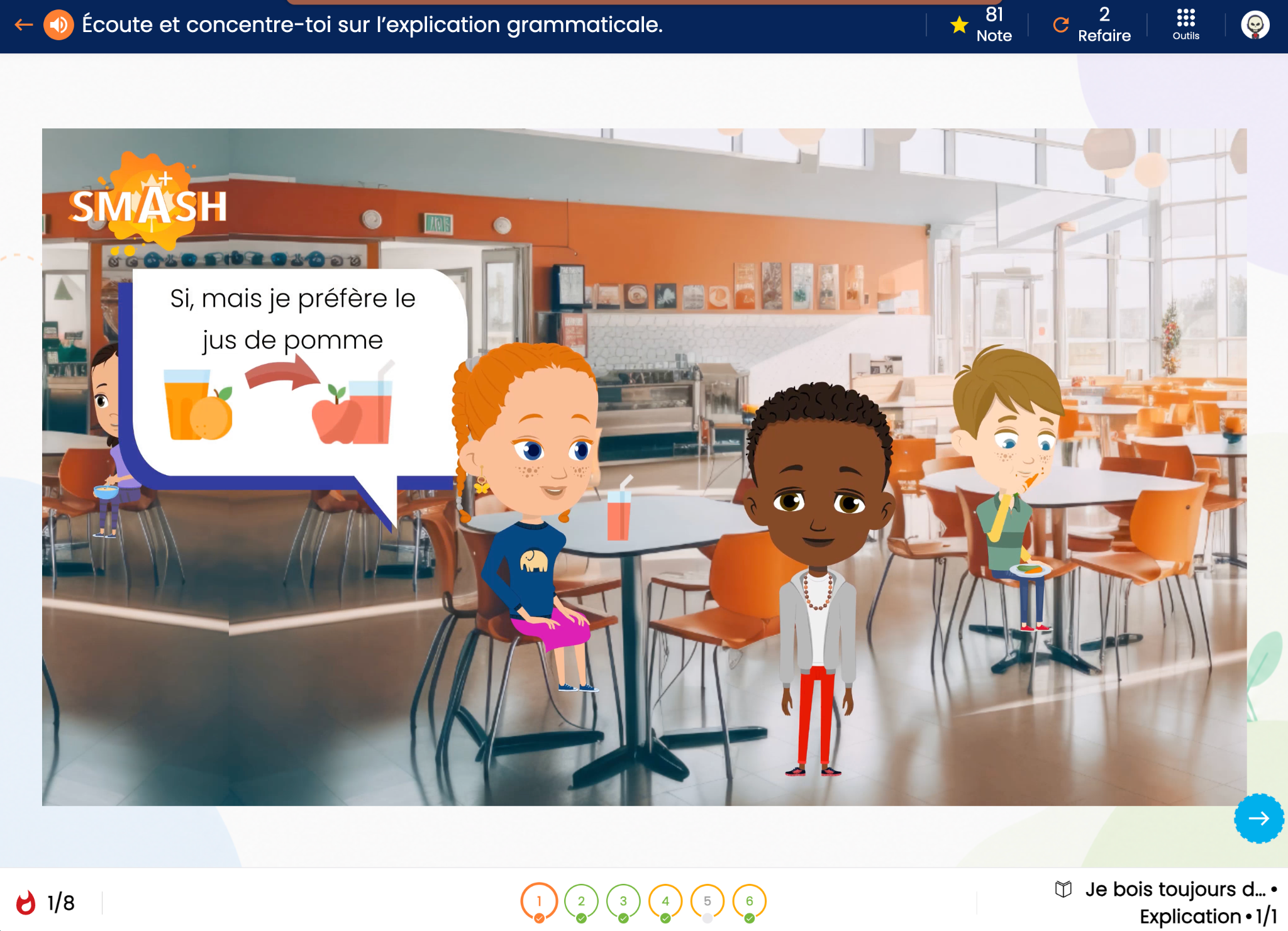
Student Portal example · Elementary French. Listen and connect language with meaning.Make learning part of your routine.
Follow connected lessons and targeted practice at your own starting point. Your individual plan includes access to a language coach for questions and feedback on open-ended activities.
Hear it. Practise it. Say it with purpose.
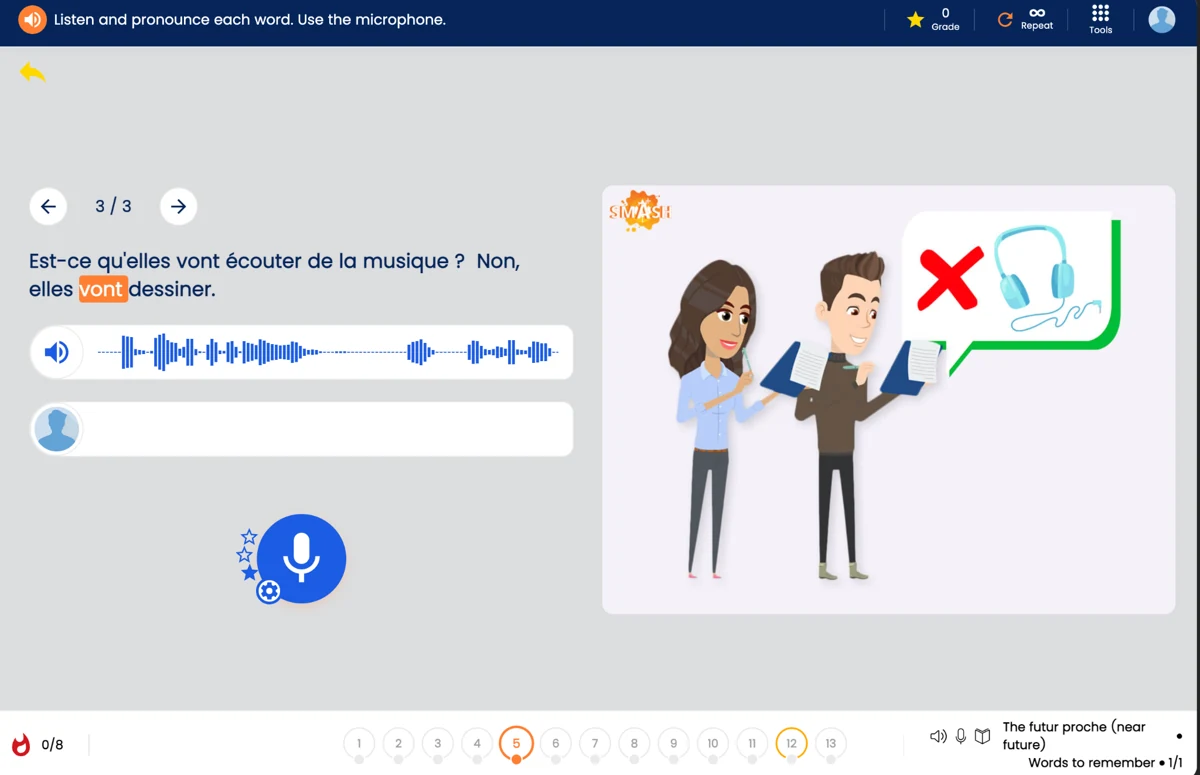
Native-speaker audio and pronunciation feedback support practice. Guided conversations and role-play help you gradually move towards more independent communication.
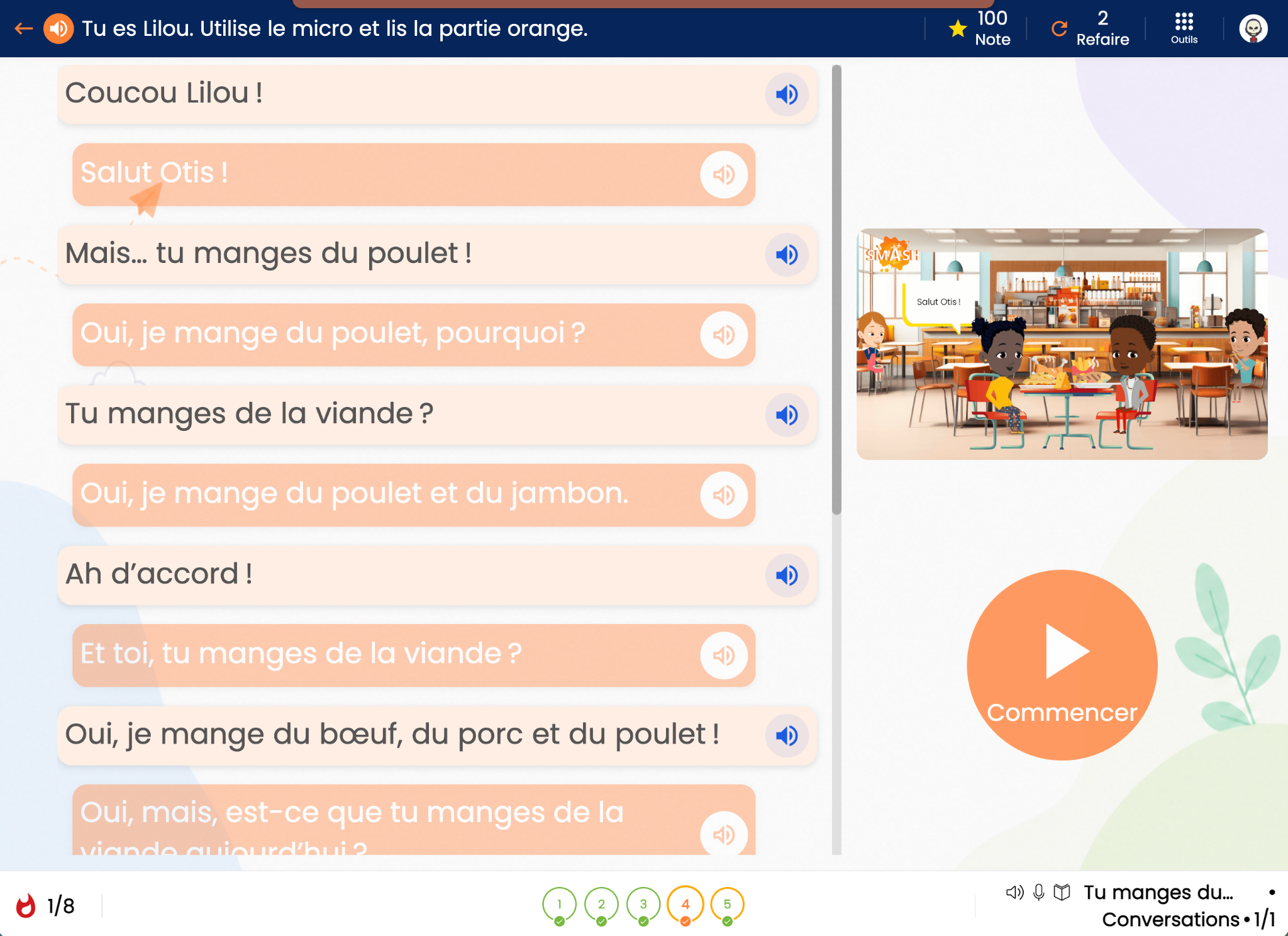
A highlighted role supports the learner’s part in a conversation.
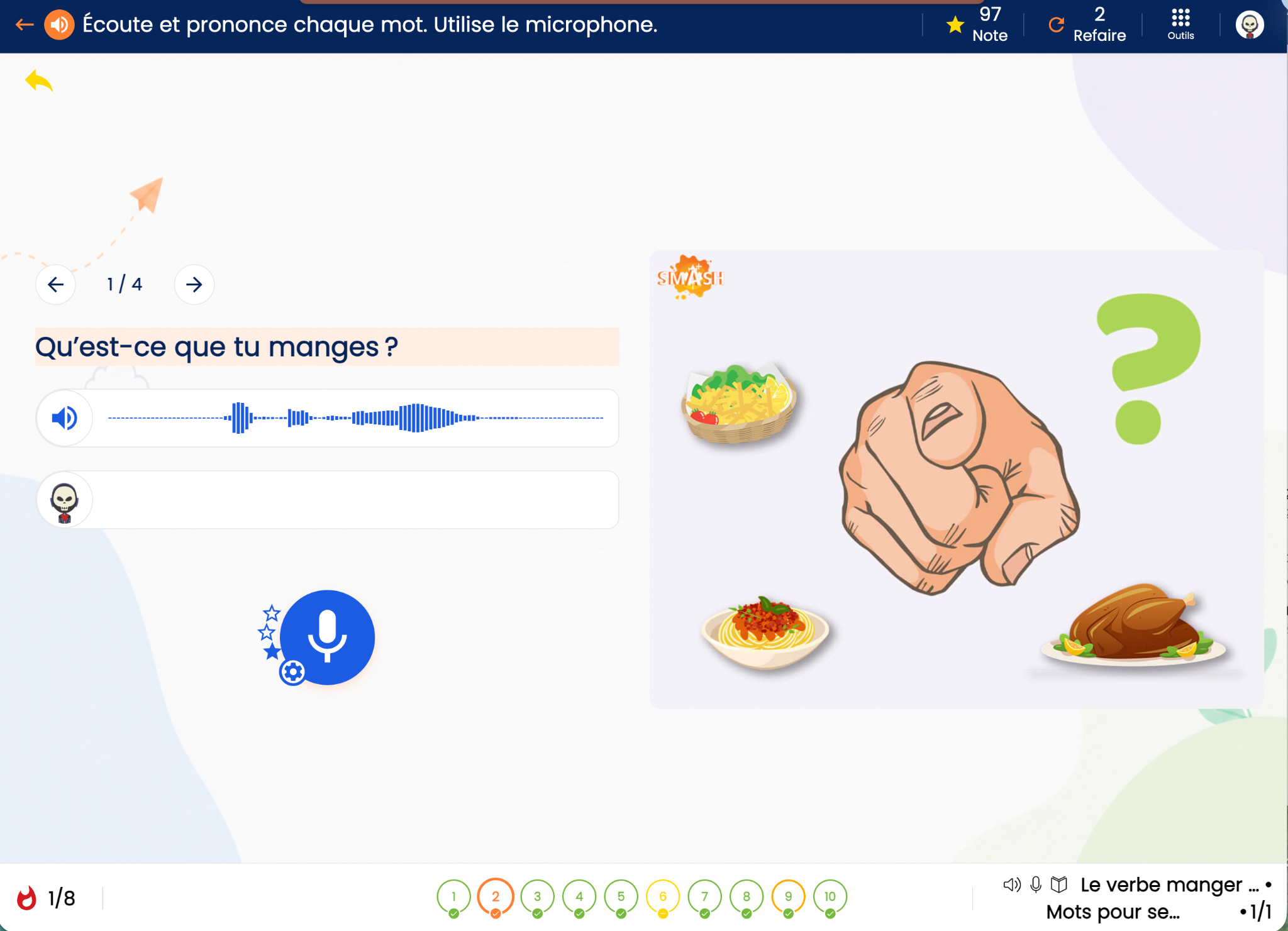
Real examples from different elementary French lessons. These show selected activities, not one continuous lesson.
From oral practice to meaningful communication.
Use the language in activities where you create your own written or spoken response. Send these through the submission button in your portal for your language coach to review. Automatically graded results are available to your coach without a separate submission.
Language to use. Not just words to remember.
Learn useful vocabulary around a theme and practise applied grammar with those words. See them come together in a level-appropriate situational video, then use the language for a meaningful purpose in written and oral action-oriented tasks.
Student Portal example · Elementary French. Listen and connect language with meaning.Immediate feedback. Coach review where it matters.
Automatically graded activity results are available to your language coach without a separate submission. For activities where you create your own written or spoken response, use the submission button in your portal to send your work to your coach for review.
Feedback you can use. A next step you can see.
Review activity results, revisit difficult skills and use feedback to guide practice. Your individual plan includes feedback from your language coach on open-ended work.
Where should I begin?Discuss your language, age or stage and goals to find an appropriate pathway.
What needs another try?Immediate feedback on automatically assessed activities helps you spot mistakes.
Who can help?Ask a language coach questions and receive feedback on open-ended activities through your plan.
Watch the product overview
Existing English-language overview. Press play to watch.
Regular practice. A clear next step. Growing confidence in using the language.
Explore the Smash Approach: Build it. Practise it. Use it.
THE SMASH APPROACH
Build it. Practise it. Use it.
Vocabulary, applied grammar and communication connect within a shared theme.
01 / VOCABULARY
Build vocabulary around a theme.
Learn useful words and expressions through visuals, listening models and interactive practice connected to the theme.
02 / APPLIED GRAMMAR
Apply it in context.
Practise grammar using the vocabulary you have learned, with sentence patterns that fit the theme and situations you could encounter.
03 / COMMUNICATION
Put language to use.
See the theme’s vocabulary and applied grammar come together in a level-appropriate situational video. Then use the language for a meaningful purpose in written and oral action-oriented tasks.
Listening
Speaking
Reading
Writing
Four interconnected language skills, developed throughout the learning journey.
You don’t need a technical setup project to begin learning at home.
Get access.
Choose the home-learning plan that suits your learner and learning window.
Find your starting point.
Tell us the language, age or stage and goals. We can help you choose an appropriate pathway.
Start learning.
Use a supported browser and internet connection on a compatible device. Nothing to install.
Your plan includes support from a language coach who assigns learning content, answers your language-learning questions and reviews submitted written and spoken responses. You can contact your coach through direct messaging in your Smash portal.
Smash is a Canadian company, founded in 2015. Explore our privacy information before choosing your home-learning plan.
Canadian home-learning plans are paid upfront for the selected duration. Longer plans have a lower monthly equivalent.
Prices are per person, for one language. Interested in learning more than one language? Contact us to discuss pricing for access to multiple languages.
Subscriptions do not renew automatically.
Start with one month
1 month
49CAD / month equivalent / person / language
49 CAD paid upfront
Six months of learning
6 months
35CAD / month equivalent / person / language
210 CAD paid upfront
Lowest monthly equivalent
12 months
30CAD / month equivalent / person / language
360 CAD paid upfront
Other durations
Duration
Monthly equivalent per person
Upfront total per person
Ask about this plan
3 months
CAD $40
CAD $120
9 months
CAD $32
CAD $288
BEFORE YOU CHOOSE
Questions learners and families ask.
Clear answers about choosing a language, learning at home, subscriptions and access.
Learning & language coach support
Choosing a program and level
How do I choose a program for myself or my child?
Start with the language you want to learn, the learner’s age, current proficiency and goal: school reinforcement, immersion support or personal learning. French, English and Spanish have different pathways and resources. Published prices are per person, for one language. Review sample activities with Smash and contact us to discuss multi-language access.
Yes. Sequenced lessons and interactive practice give you a structured path to follow independently. Choose a program for your starting level and goals, revisit earlier learning and practise using the language regularly. Your individual plan also includes language coach support for language questions and feedback on open-ended activities.
What is CEFR, and why does Smash use it?
Smash uses CEFR-based pathways to give learners and educators a structured reference for progression and communication goals. The Common European Framework of Reference for Languages (CEFR), developed by the Council of Europe, describes practical language abilities through “can-do” statements.
Why does Smash include different accents and regional vocabulary?
Languages vary from place to place, and learning those differences is part of communicating confidently. Smash introduces learners to different accents and regional vocabulary in French, English, and Spanish—for example, French words used in both France and Quebec.
This exposure helps learners understand a wider range of speakers and recognize how the same idea can be expressed in different ways.
Learning support and practical access
Do I need to speak the language to help my child?
You can support your child without being fluent in the language. Audio models, visual resources and guided practice help with learning, while you can encourage a routine and interest in using the language. The amount of adult help depends on your child’s age and starting point.
Review sample activities and ask about the language coach support included in the individual plan.
How does language coach support work?
Your plan includes support from a language coach who assigns learning content, answers your language-learning questions and reviews submitted written and spoken responses. You can contact your coach through direct messaging in your Smash portal. Automatically graded activity results are available to your language coach without a separate submission.
For activities where you create your own written or spoken response, use the submission button in your portal to send your work to your coach for review.
Could Smash suit a learner with additional learning or accessibility needs?
Schools and districts have shared positive feedback about using Smash with autistic students, students who are hard of hearing, and students with speech or articulation difficulties. These reported experiences come from school settings.
Structured, sequenced learning can support a familiar routine, while differentiated content supports different language levels. Educators also report that some students with speech or articulation difficulties appreciate oral practice without feeling repeatedly penalized for their speaking differences.
Suitability depends on the learner, activities and support available; adaptations may be needed. Smash is not a specialist intervention or speech therapy tool.
Use a supported browser on a compatible device with internet access; there is no local software to install. Computers and compatible tablets or phones can support learning, but activities and features may work differently across devices. Ask Smash to check your device and browser if you are unsure.
Printable resources complement online practice rather than making the whole platform available offline.
Not necessarily. If you already know some of the language, you may be ready to begin beyond the introductory levels. The right starting point depends on what you can understand and do, rather than which courses you have completed.
However, moving ahead before you are ready can leave gaps that make later learning harder. Build on your existing strengths, revisit foundations where needed, and work toward increasingly demanding tasks. You may also be stronger in some skills than others. Available levels depend on the selected language and program.
What helps you make real progress in a language?
Build a routine you can sustain. Around 30 minutes of focused practice each day can be a useful starting suggestion, adapted to your age, goals and schedule. Short activities help with review; sustained sessions create room to listen again, understand language patterns and build your own responses.
Progress means moving beyond recognizing words toward understanding others and expressing ideas in the language you are learning. Smash connects vocabulary, applied grammar and communication through structured lessons and active practice across listening, speaking, reading and writing. Revisit difficult points, use feedback and put new learning to work regularly.
Why can language progress feel slower at intermediate levels?
Progress can feel less noticeable when familiar conversations become manageable but longer speech, unfamiliar topics and more complex language still require effort. This is sometimes called an “intermediate plateau” or “B1 plateau”; it does not mean learning has stopped.
Smash combines scaffolded immersion, natural-speed speech and vocabulary and applied grammar practice within connected themes. Repeated practice helps learners connect ideas, choose language more precisely and respond more independently as they work toward B2, where offered.
Study goals and qualifications
What French level do French-speaking universities require?
B2 is a commonly requested minimum for French-taught university programs in France, although some programs require higher proficiency. Requirements depend on the country, university, program and applicant background. Campus France: French-language levels for study explains the context.
Smash’s CEFR-based pathways help structure learning goals within available levels. Admission depends on meeting the university’s requirements, including any required proof of proficiency.
How do DELF and DALF relate to CEFR levels?
Smash’s CEFR-based French pathways provide a reference for learning goals alongside official French qualifications. DELF covers A1, A2, B1 and B2; DALF is a separate diploma for more advanced proficiency, beyond Smash’s stated scope.
How do Smash’s English pathways relate to Cambridge English Qualifications?
Smash’s English pathways and Cambridge English Qualifications both use CEFR as a reference for progression. For you or your child, this shared reference can help connect an English-learning goal with a qualification you may consider separately.
Smash supports learning over time; a Cambridge exam assesses performance against its own requirements. Sharing CEFR levels does not establish identical content or exam readiness, and completing a Smash level does not award a qualification or guarantee an exam result. See Cambridge English: CEFR and international language standards.
Plans & billing
Plans and payment
Does one plan cover my whole family?
No. Prices are per person, for one language. Each learner needs their own plan. Contact us to discuss pricing for access to multiple languages.
Are the longer plans billed monthly?
No—the longer plans are paid upfront, and the displayed monthly amount is an equivalent rate.
Home-learning plans: upfront cost
Plan duration
Upfront cost (CAD)
1 month
$49
3 months
$120
6 months
$210
9 months
$288
12 months
$360
Will my subscription renew automatically?
Subscriptions do not renew automatically.
How do I confirm pricing outside Canada?
The published home-learning prices are in Canadian dollars (CAD). For purchases in the United States or elsewhere outside Canada, Smash can provide the applicable currency, offer and total cost, including any taxes. Your payment terms identify the amount to pay for the selected plan.
Can I use the annual school licence for home learning?
School-provided access and individual home-learning plans are separate offers. If your child already uses Smash through school, ask their school teacher what access is provided before purchasing a separate plan. Published home-learning prices are per person, for one language.
Are curriculum and platform updates included?
Standard curriculum and platform updates within your subscribed program are included during an active subscription, unless your plan or agreement specifies otherwise. Separately priced offerings are identified in the applicable offer or agreement.
How do I get started and ask for help?
Tell Smash who is learning, which language interests you and your current experience. Review the program and sample activities, then choose your home-learning duration and arrange access and payment. Your individual plan includes language coach support for language questions and feedback on open-ended activities.
Once access is arranged, follow a suitable pathway and build a routine you can sustain.
The Privacy Policy explains educational data such as activities, progress and oral recordings, technical information needed to operate the platform, and adult account or billing details. It also describes optional identifiers, access, retention and deletion.